
When the World Is in Flux, Design Brings Balance
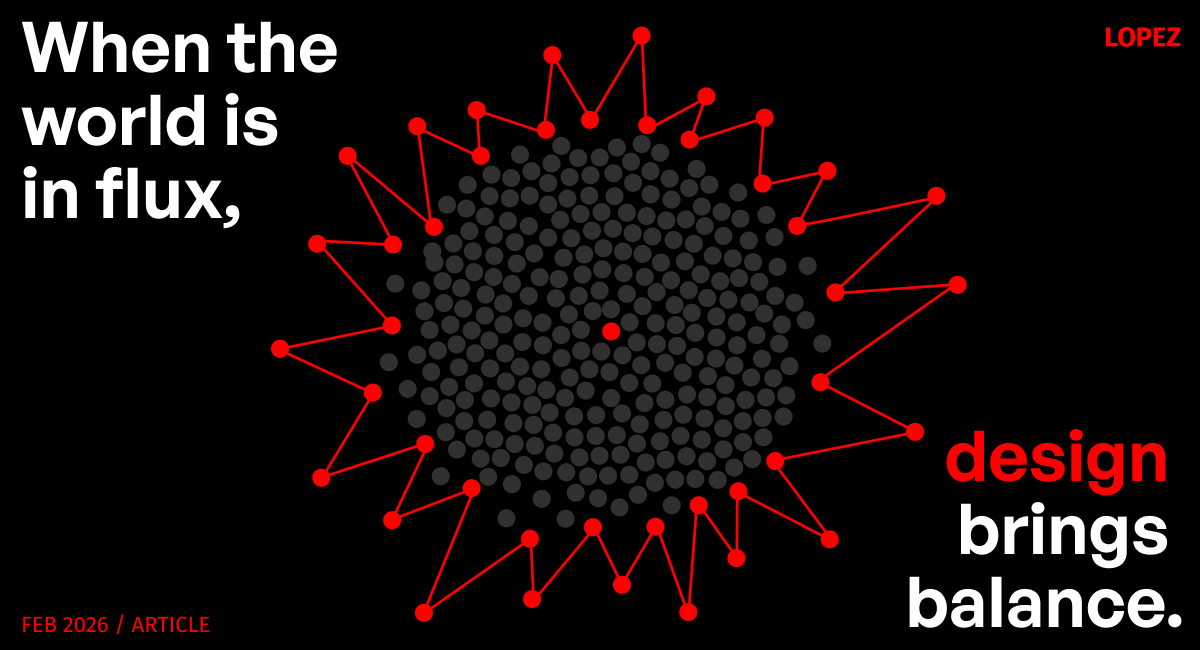
We are living through a period of exponential change. Not change that arrives, settles, and creates a fresh direction, but change that keeps compounding unpredictably. Technology, a major driver, is advancing quickly. Meanwhile, we are overwhelmed with information. Decisions are expected faster, often made with incomplete context, and increasingly carry consequences that are hard to reverse.
When everything is moving hastily and together, organisations are pushed to act before they have come to an informed decision. Capabilities are abundant. Tools are powerful. Advice is everywhere. What is scarce is the ability to cut through the noise and make clear, committed choices while things accelerate. There are no clear-cut answers to these complex problems of the 21st century. In this environment, the real challenge is not speed: it’s about finding clarity and the ability to remain balanced while acting without full certainty. Designing, in this context, is also not about making things look better or work faster. It is about shaping direction. Clarity is lost not through bad decisions, but through too many acceptable ones. Therefore, deciding what matters, what does not, and what must be left out is critical even when several options appear reasonable. This is where many decisions start to weaken. Under pressure, the most dangerous choices are often the ones that almost work. They feel safe. They avoid friction. But taken together, they blur focus and dilute intent.
There is an old saying: there is no point in being fast if you are a lousy shot. Designing well under these conditions requires restraint. It means slowing down just enough to ask a better question. It means eliminating paths that dilute direction, even when they are tempting. It means holding coherence when speed is rewarded more than thought. And it cannot be automated or delegated to technology, which often appears to provide quick solutions. In recent years, some of the most consequential decisions have been these acts of restraint: Apple’s refusal to rush consumer-facing AI, Basecamp’s decision to keep automation out of clarity-driven tools, and EU regulators' delay in deployment until boundaries are defined. These are just a handful who are willing to push back. Otherwise, even if capability is in abundance, good judgment is scarce.
As timelines compress and visibility increases, these qualities do not sustain themselves. They have to be actively maintained. Holding steady does not mean resisting change. It means protecting what should not drift: the way decisions are made, the rigour behind them, and the ability to prioritise long-term clarity over short-term momentum. At some point, this kind of decision-making becomes difficult to sustain alone. Complexity increases. More voices enter the room. Stakes rise. This is where design, as a professional practice, begins to play a role—not as a layer added at the end, but as a partner in shaping direction and holding judgment with care.
Good designers do not bring ready-made answers. They bring the discipline to ask better questions, reduce noise, and help organisations choose—and own those choices. Their value lies not in reacting to change, but in helping others navigate it with clarity, balance, and responsibility. In an age of flux, balance does not come from standing still. It comes from designing choices carefully so that as you evolve with a new order of change, you do not lose your footing along the way.
Anthony Lopez,
Founder and Chief Creative Director,
LOPEZ
Edited by: Sujatha Shankar Kumar
Related Projects
WHO Discovery Experience
CONCEPT STRATEGY + BRANDING + EXPERIENCE + CREATIVE DIRECTION

AI Cohort 2026
STRATEGY + BRANDING IDENTITY + VISUAL SYSTEM + UI/UX

More Articles
The Season of Discernment

In a World of Infinite Answers, Design Can Decide What Matters

Transaction or Transformation?

Follow us on
Read more Articles from this Edition
Feb Tue, 2026
The think work balance
Read More>
Feb Tue, 2026
Discipline before visibility
Read More>
Feb Tue, 2026

Orchestrating a Summit at Global scale: What it Takes
Read More>
Activation
Project Management
Supervision
Fabrication & Installation
© 2025 Lopez Design Pvt. Ltd. All rights reserved