
Orchestrating a Summit at Global Scale: What it Takes
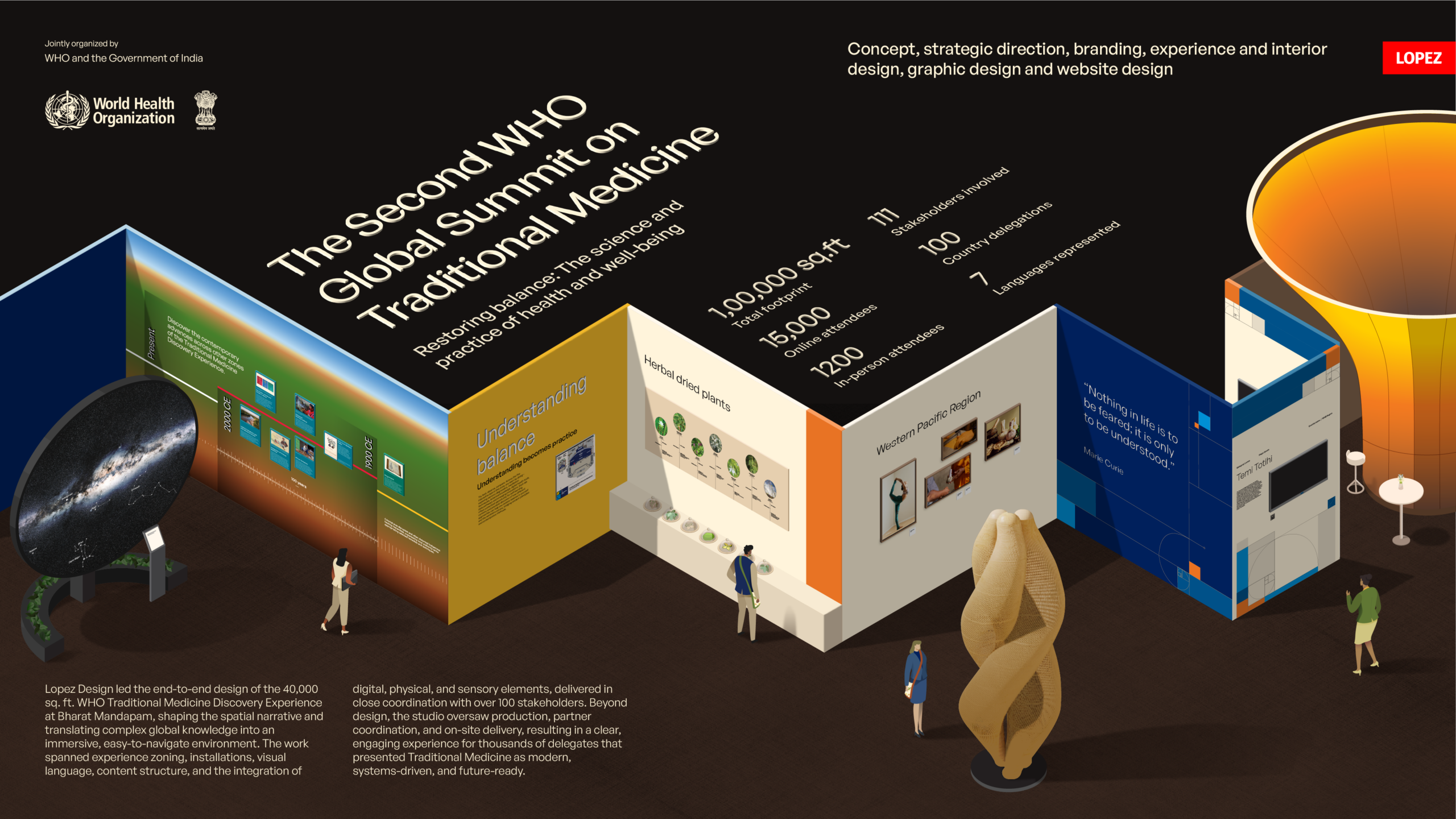
The Second WHO Traditional Medicine Summit was held in New Delhi from December 17th to 19th, 2025 at Bharat Mandapam, focusing on advancing evidence-based traditional practices under the theme "Restoring Balance: The science and practice of health and well-being”. Spread across 100,000 sq ft, the Summit engaged 100+ country delegations represented by 100 ministers. Organized by the WHO and India's Ministry of Ayush, it brought together global experts to integrate traditional medicine into mainstream health systems. The Traditional Medicine Discovery Experience alone brought together 111 subject experts across disciplines and geographies with a coherent narrative. Operating across seven official languages, the Summit reached thousands of participants both on ground and online.
Large global projects are often described through numbers and milestones. You are rarely given the inside story — where dozens of cultures, protocols, belief systems, and deadlines are colliding in real time, and the margin for failure is almost zero. What is the on-the-ground reality of designing at a global scale? What are the inherent challenges? What were the parameters which we had to fulfil, without fail, to achieve overall excellence? How much does client-designer partnership and trust matter in foundational innovation? Here are five key learnings that shaped up as we set out to create our studio’s most massive project yet in India’s capital city, across media and spaces, professions and cultures, governments and organizations, to win hearts and minds.
Learning 1: Strategic framework and Conceptual direction make the cutting-edge differentiation
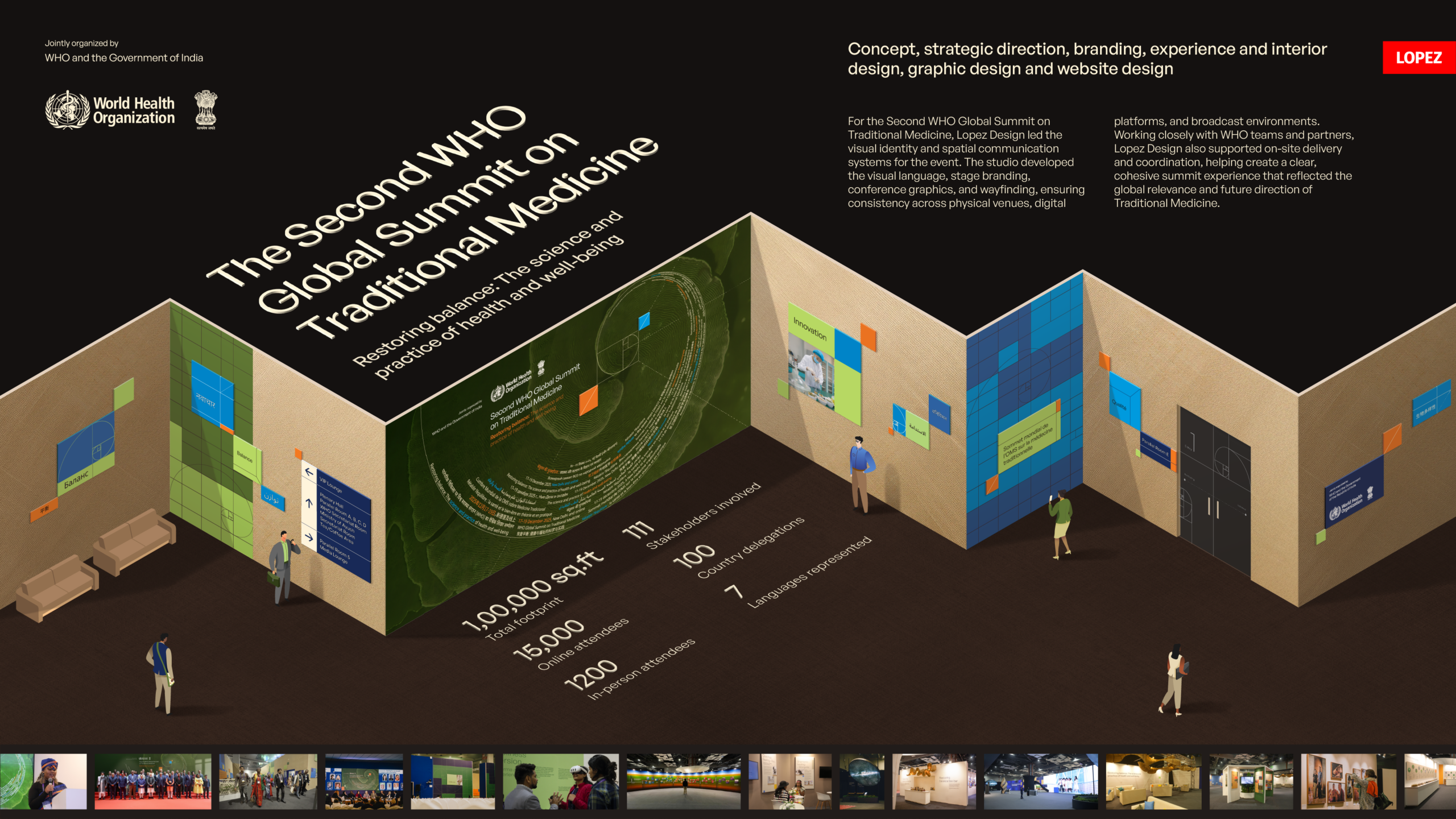
Lopez was entrusted with bringing the vision of Restoring Balance to life. Our design studio played a pivotal role across multiple touchpoints, including Branding, Concept Renders, Conceptual Framework & Strategic Direction, Experience and Exhibition Design, Event Design, Graphic Design, Website Interface, and overarching Creative Direction. The visual strategy drew from the fibonacci curve and its presence across Nature, making a self-explanatory statement about how mathematics, science and Nature are inherently connected. This became the channel for the core experiences, connecting all visual metaphors.
“Across video, film and performance, carry-home mementoes, poster graphics, exhibit panels, website and peripherals, the fibonacci curve came alive bringing together the visual story coherently, under one umbrella. This is the power of brand strategy when conceptualised and thought-through well: it becomes engaging when implemented at scale to connect with delegates, governments, and people from all walks of life”.
Learning 2: Speaking for great numbers means great responsibility to every member
The Second WHO Global Summit on Traditional Medicine was positioned as a vital platform to validate traditional medicine’s benefits by aligning with scientific approaches, policy and regulatory frameworks towards WHO’s vision of ‘Health for All’. This was a place of convergence, bringing together global leaders, researchers and practitioners to accelerate collaboration for system-level change. All communications at the convention had to speak for this shift of traditional medicine from the periphery to the center.
“Creating inclusive communications meant we had to be responsive and nuanced, allowing for the design system to be open and flexible, not rigid. When Indigenous partners requested the image of an ancient Baobab tree on a wall to revive the “energy” — something that was not earlier planned — our team located a large-format vinyl press overnight to bring this powerful cultural symbol into the exhibit.”
Learning 3: Communicating complex issues requires integration, not compartmentalization
The project’s vast implementation proved our deep belief in design thinking for holistic approaches and advocacy of design as an enabler. Instead of breaking down the intent to operate in silos, we chose to deploy design as the central force bringing together multiple partners and workstreams, aligning stakeholders, and reducing the distance between intent and execution. Spanning geographies, cultures, institutions, and systems, across 111 stakeholders representing over 100+ countries, design became an integrating mechanism through which complex requirements were organized, negotiated, and translated into action. Our immersion in strategic decision-making brought us closer to the project’s core purpose: to build alignment across different stakeholders and enable a shared global vision to move forward with clarity and coherence.
“The Timeline Wall in Zone 1 alone carried 12,500 years of medical history, across nearly 130 visuals, each passing through 10–12 rounds of international approvals. And this was just one section. Across four zones, the studio was managing northern and southern constellations, five research labs with 276 panels, 21 exhibition walls in Zone 3, plant-tea labels, specimen jars, digital interfaces to gather crowds, while constantly shifting content. All of this had to be done in coordination with WHO teams across time zones, ministries, and Indigenous representatives.”
Learning 4: Unrestrained trust led to unprecedented global teamwork with unmatched professionalism
The scale and complexity of the project demanded deep collaboration across disciplines. Its implementation was possible only because of the client’s belief in us to deliver. WHO-GTMC’s and Ministry of Ayush’s unbounded sense of trust, giving us the mandate and working closely with our team, gave the project a firm foundation on which we could build immensely. We let go of our need for personal control, completely trusting each of our partners to play their part. The result is proof of what shared conviction and mutual trust can achieve, demonstrating collective strength and unified vision: strategy, design and execution all moved synchronously, not in separate highways. Working with faith in each other’s intent and expertise also allowed the collective to operate beyond individual roles and maximize combined potential.
“One of the earliest signs of working at scale happened on a late-night call with a WHO vendor from Geneva. Feedback was delivered not in rapid-fire instructions, but in carefully paced speech with deliberate pauses to drive the message home. The exchange was halted every now and then, to give us a breather, so that we were not overwhelmed. In a studio racing against immovable deadlines, it felt almost surreal — yet it revealed something profound: at this scale, clarity is not about speed, but about creating space for understanding."
Learning 5: Communications of complex ideas in layered experiences aligned across multi-stakeholders and a diverse global audience
The challenge was not execution, but alignment. The task was to translate a complex ambition into an experience that was coherent, navigable, and meaningful across cultures, disciplines, and contexts without diluting nuance or depth for a diverse, multi-stakeholder global audience.The shared visual and narrative language we developed allowed scientists, policymakers, and Indigenous practitioners to comprehend the same information without cultural bias or hierarchy. Layered spatial, graphic, and digital systems ensured complex knowledge could be accessed intuitively at multiple depths, from quick understanding to detailed exploration.
“Creating the huge display of works across the space was like orchestrating a symphony. In other words, there was an invisible operating system at work. One of our team members built a numbering and colour-coding framework for over 600–700 graphic files across the Summit and Expo — every wall, every section, every panel mapped by location, size, content and print format. An Excel master sheet drove the entire fabrication workflow so the execution teams could print and paste without creating a bottleneck at the design studio.”
The true projection of good design is simplicity. None of the complexity behind the scenes appears in the actualization. The entire exhibit presents calm coherence and dignity. This is not just luck. This is what happens when a studio is built to hold uncertainty, adapt in motion to changes in plan and protect meaning. At Lopez, this is what design at global scale truly is: not egotistic control but harmony through orchestration.
Editor-in-Chief: Sujatha Shankar Kumar
Written by: Sukanya Panda, Vishal Goyal, Somasundaram W
Related Projects
WHO Discovery Experience
CONCEPT STRATEGY + BRANDING + EXPERIENCE + CREATIVE DIRECTION

AI Cohort 2026
STRATEGY + BRANDING IDENTITY + VISUAL SYSTEM + UI/UX

More Articles
The Season of Discernment
In a World of Infinite Answers, Design Can Decide What Matters

Transaction or Transformation?

Follow us on
Activation
Project Management
Supervision
Fabrication & Installation
© 2025 Lopez Design Pvt. Ltd. All rights reserved