
Design is a Governance Responsibility
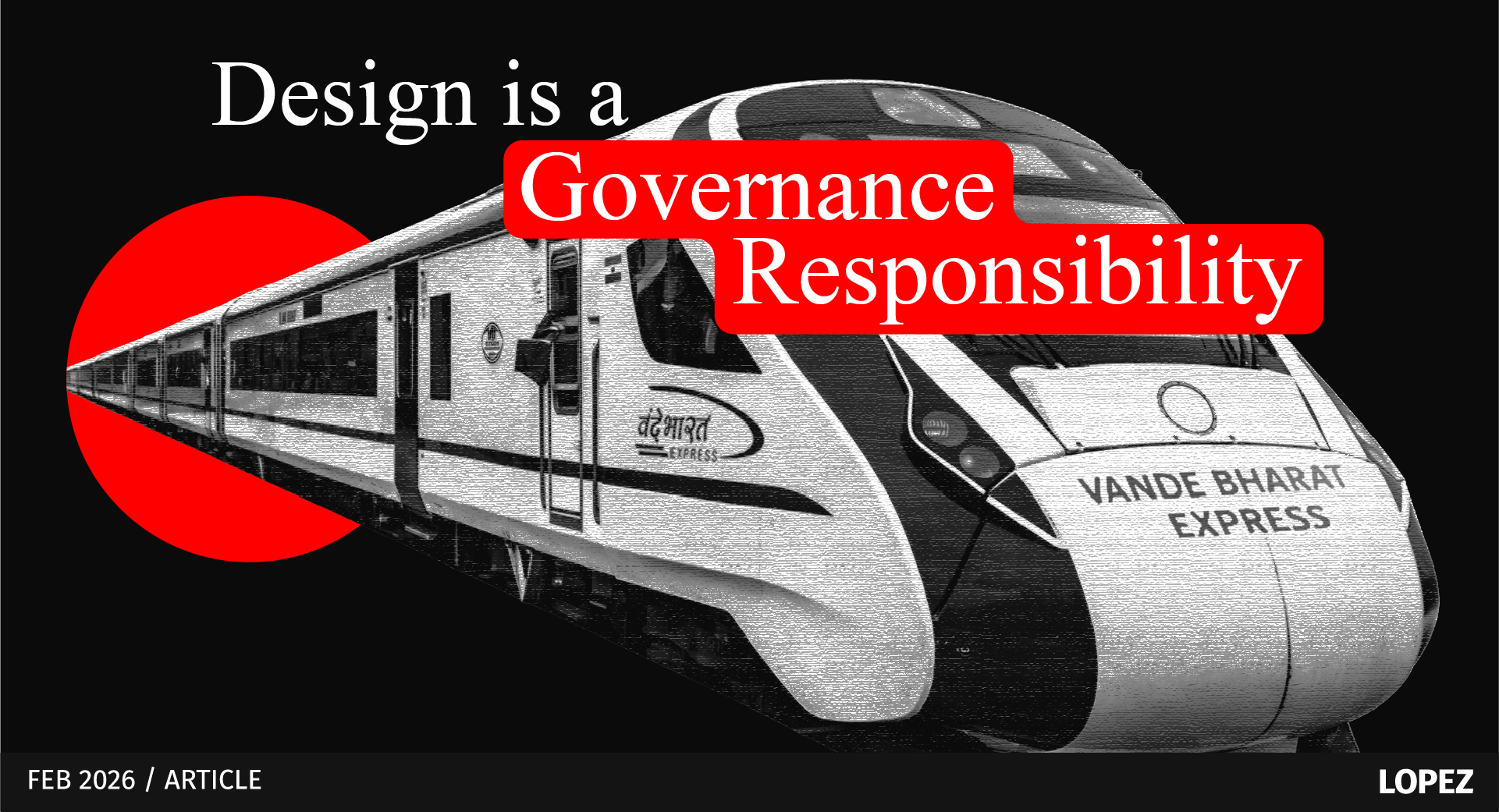
Professor Kirti Trivedi’s recent critique of the Vande Bharat Express deserves serious attention. His observation that “the crudeness of detailing and design is to be seen to be believed” is not merely a comment on aesthetics. It is about something far more fundamental: the role of design in public governance.
When a public project is presented as a flagship achievement, it must embody excellence across every dimension — engineering, detailing, usability, materiality, communication, durability. Not as isolated improvements, but as a coherent whole. Design is not a cosmetic layer applied after decisions are made. It is the discipline that brings coherence, clarity, and integrity to complex systems.
Professor Trivedi points to what many professionals quietly observe: India does not lack talent. Our automotive industry, aerospace sector, digital platforms, and private infrastructure demonstrate that we are fully capable of meeting global standards. What often falters is not capability, but institutional intent — the seriousness with which design is commissioned, protected, and upheld throughout execution.
Design begins long before form. It begins with framing the right brief.
The process is not about solving a single visible problem. It is about understanding the system in its entirety — cost constraints, passenger behaviour, hygiene, comfort, accessibility, maintainability, lifecycle durability, visual coherence, and operational efficiency. A rigorous design process interrogates assumptions. It eliminates incoherence. It tests decisions against the original intent. Through refinement, it removes falsification and what does not serve the whole.
When this discipline is absent or diluted by haste, influence, fragmented commissioning, or surface-level decision-making, the outcome reveals it. Not in one flaw, but in cumulative inconsistency — proportions that feel unresolved, graphics that lack coherence, hardware that is not optimised for space or comfort, detailing that does not reflect global benchmarks. Each gap may seem small in isolation, but together they signal something larger.
We have also seen the opposite outcome.
The Delhi Metro stands as evidence that when institutional discipline, clear commissioning, and design standards are upheld, the result is transformative. Beyond infrastructure, it reshaped behaviour. People respected the environment because it was designed with clarity and durability. Good design elevates conduct. It builds collective pride. It sets behavioural norms.
Public systems are not neutral objects. They shape culture.
Governance, therefore, is not only about funding and execution speed. It is about deciding what standards are non-negotiable. Commissioning the right expertise for the right intent. Protecting design integrity from dilution. Recognising that speed without precision produces mediocrity at scale.
It is no achievement to be fast if we have not been rigorous.
Design is a governance responsibility because it determines how citizens experience the nation in everyday life. It communicates what we value, what we tolerate, and what we aspire to become.
The question before us is not whether we have the capability. We do.
The question is whether we choose to make design central to public decision-making.
Because design outcomes ultimately reflect national intent.
And intent defines the quality of what a nation builds for its people.
Anthony Lopez,
Founder and Chief Creative Director,
LOPEZ
Related Projects
WHO Discovery Experience
CONCEPT STRATEGY + BRANDING + EXPERIENCE + CREATIVE DIRECTION

AI Cohort 2026
STRATEGY + BRANDING IDENTITY + VISUAL SYSTEM + UI/UX

More Articles
The Season of Discernment

In a World of Infinite Answers, Design Can Decide What Matters

Transaction or Transformation?

Follow us on
Read more Articles from this Edition
Feb Tue, 2026
The think work balance
Read More>
Feb Tue, 2026
Discipline before visibility
Read More>
Feb Tue, 2026

Orchestrating a Summit at Global scale: What it Takes
Read More>
Activation
Project Management
Supervision
Fabrication & Installation
© 2025 Lopez Design Pvt. Ltd. All rights reserved