
The Medium has taken over. What’s next?
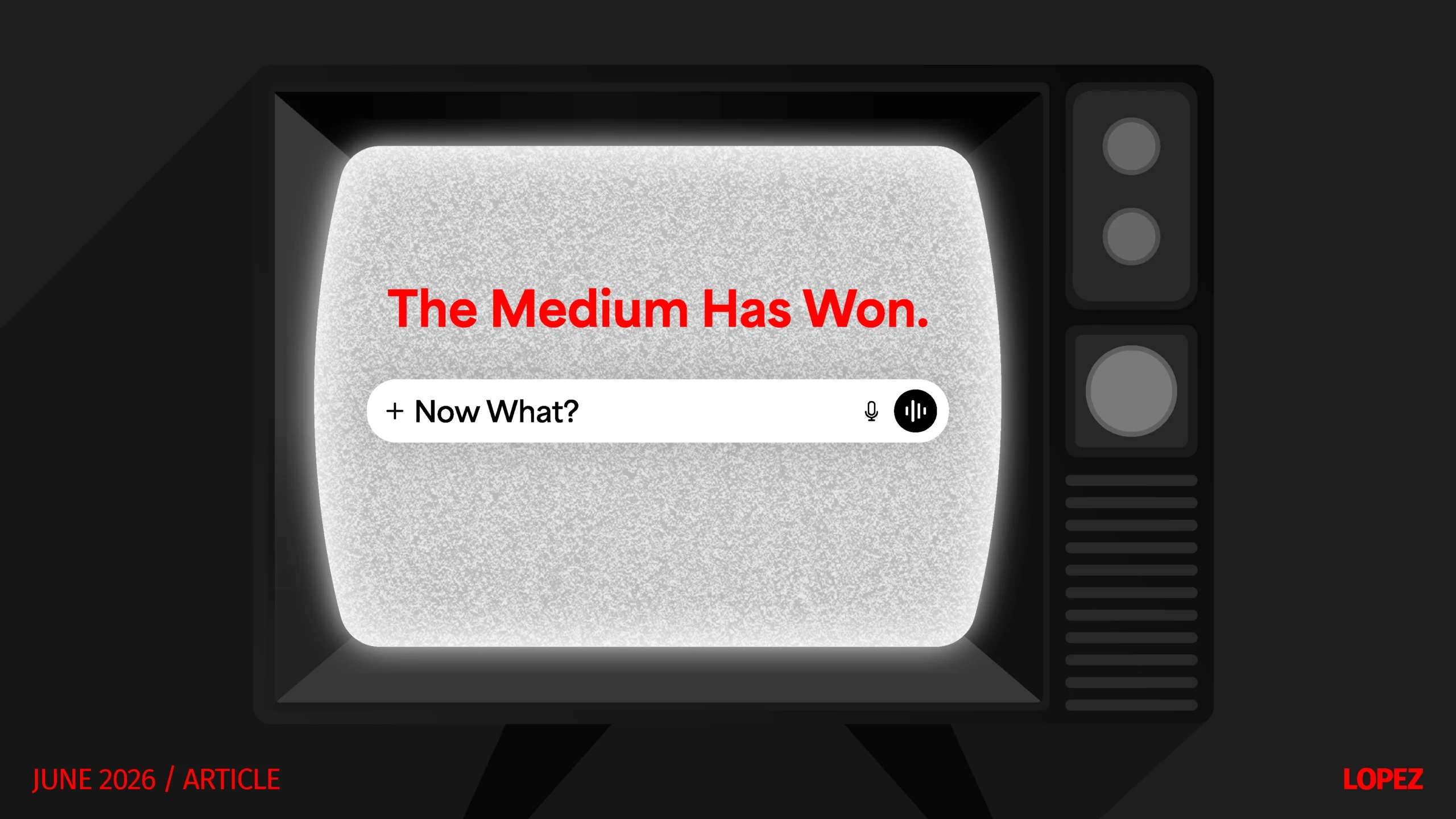
When Marshall McLuhan coined the famous “The medium is the message” in 1964, he had foreseen how a medium can have far reaching effects on social behaviour. Humans created AI, but AI has shaped us in ways beyond we could predict. Artificial intelligence is the first tool, technology and medium that can carry on an intelligent dialogue, offering opinions and arguments. Can we stay ahead?
Marshall McLuhan’s arguments in 1964 should have stopped us cold.
"The effects of technology do not occur at the level of opinion or concepts, but alter sense ratios or patterns of perception steadily and without any resistance. The serious artist is the only person able to encounter technology with impunity, just because he is an expert aware of the changes in sense perception."
I first encountered McLuhan at the National Institute of Design in the early 1980s. But the experience of what he articulated came earlier, in the 1970s, when we were kids who used to walk to our neighbour's house just to watch television. The roads would empty. Nobody could do anything else. That was the pull of the medium. We created it, and it dominated how we spent our time.
The danger of the visual and auditory media is that they can manipulate the message efficiently. From cinema to real stories, television and radio have altered people, quietly and without resistance, before anyone noticed what was happening.
Today, we have gone many steps further.
We are no longer merely being shaped. We are being replaced.
Earlier technologies replaced tools and professions by doing their tasks. The horse buggy was replaced by the motor car. The typewriter was replaced by the computer. Mental arithmetic became weaker with the calculator to do our job. We rely less on memory since we have phones to store our lists and numbers. Essentially, most of these advances are seen as progress, as the brain can now spend time on other things rather than the mundane tasks it was earlier dealing with.
But let’s go back to McLuhan and how the medium can change the way we do things. What happens when something starts doing your thinking for you? You rely less on your own judgment, you put in less effort to search for alternatives. Searching, comparing, questioning, composing and decision making suddenly becomes the machine’s accountability, not yours. In essence, we blindly put our trust in AI to solve our problems, with the belief that all the data and the patterns come from aggregated sources supplied by human beings.
While television has the power to shape our beliefs and opinions, AI is altering our power of discernment and self-belief. Every question is answered instantly. Every decision is supported. Every gap in knowledge is filled before the discomfort of not knowing has had time to do its real work. Anyone with the same prompt could have produced the same output. The work does not need them. They are interchangeable. And because the output looks good and arrives fast, nobody notices, least of all themselves. We may soon need a new term for people who are busy doing nothing: the numb dumb.
Knowledge is now a commodity. Wisdom is becoming extinct.
I have spent thirty years watching talented people work. The most dangerous pattern I see in my studio, in the industry, and in the world is not ignorance. It is the opposite. Highly intelligent people with access to everything, who struggle to cut through to what is actually true. Knowledge fills the room. Wisdom is what defines what the room actually needs.
For most of human history, knowledge was scarce. We arrived at wisdom by wrestling with that scarcity, by having to search, think, judge, choose, and live with what followed. Today knowledge is infinite, instant, and free. You do not need to know. You just need to ask.
Wisdom is knowing which question was worth asking in the first place. That is what AI cannot give you. And that is precisely what we are allowing to weaken, the human capacity to make a definitive decision.
As knowledge becomes universally accessible at a prompt, the muscle that judgment requires stops being used. Muscles that stop being used disappear. We become - collectively and gradually, the numb dumb. Capable of accessing everything. Capable of judging nothing.
There are three responses to this. Only one works.
The first is to step away entirely and refuse to use the medium. You preserve the self within. The integrity of the analog photographer who persisted with film when digital medium arrived was not wrong. They were protecting something real, but then they refused to move with the world. Would we keep walking when we had the choice of using a motorised vehicle to get somewhere faster?
The second is the answer everyone gives is to stay agile, adapt, and keep up. But consider what you are actually being asked to keep up with. Unlike previous innovations, AI capability is not growing incrementally. It is compounding at an exponential rate, faster than policies, laws, institutions, and human awareness can follow. Again, would we try to outrun a motor vehicle that’s moving at 100 km/hr? The third way is to surf.
The surfer does not fight the wave and get the better of it. The surfer rides the wave, but moves on their own terms. That requires something the runner is not in a position to do, awareness of the wave itself, not just the road or the motor-vehicle.
This is not a romantic idea. It is the only one that holds.
What surfing actually looks like.
It is not a framework or a tool. It is a quality of attention, practised until it becomes instinct.
It looks like this. You are in a room. An answer is available. It is good enough. The client will accept it. The deadline is tomorrow. And something in you says — I have not yet arrived. That moment of recognition is the practice. What you do next is the choice.
At Lopez, we practise this as falsification. Every concept is treated as a hypothesis. We do not stop when it looks right. We stop only when it has survived serious attempts to break it. That discipline — applied to every brief, every decision, every moment when the easy answer is sitting on the table — is what it means to surf rather than be swept.
Others have done this at a scale most of us will never face.
When B. R. Ambedkar set out to write the Indian Constitution, he studied every major constitutional document in the world. The knowledge was available. But knowledge alone could not help him write a constitution for 562 princely states, dozens of languages, centuries of injustice, and the aspirations of 350 million people. It was his wisdom to ask what India specifically needed — not what had worked elsewhere. The result has held one of the most complex democracies in human history for over seventy-five years.
Charles and Ray Eames did something similar for design in India. They did not arrive with a ready-made answer. They travelled, observed, absorbed, and asked what a newly independent India needed from design. The India Report did not merely recommend a school. It asked a deeper question - how could design help a country modernise without losing its cultural intelligence?
If they had relied on knowledge alone, they would have imported a European design school model. It was their wisdom that helped them recognise that India needed its own design imagination, rooted in its people, crafts, industries, materials, and ways of living. That question helped shape the foundation for the National Institute of Design and, through it, much of how modern design education in India came to understand itself.
Neither came from a prompt. Both came from people who had developed, through years of practice, the capacity to ask what the available answer could not reach.
We have to rigorously continue asking these questions today, shaping our continued capacity for discernment and judgment.
The irony is almost unbearable.
We have McLuhan. We have the evidence. The medium is not hiding — it is in our hands, our work, our conversations, our creative decisions, every hour of every day. And we are victims of it anyway, because awareness without the discipline to act on it is just another form of numbness.
Knowing that AI is changing how you think does not protect you from AI changing how you think. Only the sustained practice of judgment through difficulty, through failure, through the refusal to accept what almost works builds the awareness McLuhan was describing sixty years ago.
The people who develop this are rare because they make a conscious choice to stay in the room a little longer. They choose the harder question over the available answer. They choose, again and again, to remain the irreplaceable person in the work, the one whose specific judgment, experience, and way of seeing cannot be replicated by anyone with the same prompt.
The medium is ahead of us.
The only question is whether enough of us will choose to become the kind of people who can encounter it with impunity.
That choice does not happen at the level of opinion.
It happens in the moment you catch yourself accepting an answer because it was there not because it was true. That pause. That small refusal.
Doing it will be hard. Practice will make it easier. Until one day it is simply who you are.
Anthony Lopez is the founder of LOPEZ, a strategic design consultancy with thirty years of practice across strategy, identity, environmental design, wayfinding, and communications. LOPEZ’s work includes Accel, Ayushman Bharat, Bihar Museum, Kartavya Path, VIP Industries, and PMNCH.
Anthony Lopez,
Founder and Chief Creative Director,
LOPEZ
Related Projects
WHO Discovery Experience
CONCEPT STRATEGY + BRANDING + EXPERIENCE + CREATIVE DIRECTION

AI Cohort 2026
STRATEGY + BRANDING IDENTITY + VISUAL SYSTEM + UI/UX

More Articles
The Season of Discernment
In a World of Infinite Answers, Design Can Decide What Matters

Transaction or Transformation?

Follow us on
Read more Articles from this Edition
Feb Tue, 2026
The think work balance
Read More>
Feb Tue, 2026
Discipline before visibility
Read More>
Feb Tue, 2026

Orchestrating a Summit at Global scale: What it Takes
Read More>
Activation
Project Management
Supervision
Fabrication & Installation
Follow Us
© 2025 Lopez Design Pvt. Ltd. All rights reserved