
Forum No.9
3rd Sep 2016
Forum No.9
3rd Sep 2016
Forum No.9
3rd Sep 2016
Forum No.9
3rd Sep 2016
Forum No.9
3rd Sep 2016
COLLABORATION | TAKES THE (W) RIGHT FLIGHT
COLLABORATION | TAKES THE (W) RIGHT FLIGHT
COLLABORATION | TAKES THE (W) RIGHT FLIGHT
COLLABORATION | TAKES THE (W) RIGHT FLIGHT
COLLABORATION | TAKES THE (W) RIGHT FLIGHT
FOUNDER & DIRECTOR • Y-WALLS DESIGN
Preksha Baid
FOUNDER • DIFFERENTURE
Aakriti Kumar
GRAPHIC BOOK DESIGNER
Rukminee Guha Thakurta
FOUNDERS • POOCHKI
Ishanee and Anirudh
HUMANITIES & SOCIAL SCIENCES EXPERT
Raj Ayyar
FOUNDER & DIRECTOR • Y-WALLS DESIGN
Preksha Baid
FOUNDER • DIFFERENTURE
Aakriti Kumar
GRAPHIC BOOK DESIGNER
Rukminee Guha Thakurta
FOUNDERS • POOCHKI
Ishanee and Anirudh
HUMANITIES & SOCIAL SCIENCES EXPERT
Raj Ayyar
FOUNDER & DIRECTOR • Y-WALLS DESIGN
Preksha Baid
FOUNDER • DIFFERENTURE
Aakriti Kumar
GRAPHIC BOOK DESIGNER
Rukminee Guha Thakurta
FOUNDERS • POOCHKI
Ishanee and Anirudh
HUMANITIES & SOCIAL SCIENCES EXPERT
Raj Ayyar
FOUNDER & DIRECTOR • Y-WALLS DESIGN
Preksha Baid
FOUNDER • DIFFERENTURE
Aakriti Kumar
GRAPHIC BOOK DESIGNER
Rukminee Guha Thakurta
FOUNDERS • POOCHKI
Ishanee and Anirudh
HUMANITIES & SOCIAL SCIENCES EXPERT
Raj Ayyar
FOUNDER & DIRECTOR • Y-WALLS DESIGN
Preksha Baid
FOUNDER • DIFFERENTURE
Aakriti Kumar
GRAPHIC BOOK DESIGNER
Rukminee Guha Thakurta
FOUNDERS • POOCHKI
Ishanee and Anirudh
HUMANITIES & SOCIAL SCIENCES EXPERT
Raj Ayyar
TEXTILE DESIGNER & FIBER ARTIST
Gopika Nath
FOUNDER • COLLECTIVE CRAFT
Sibanand Bhol
LANDSCAPE & ARCHITECTURE
Gaurav Kapoor
CEO & PRINCIPAL DESIGNER
Anthony Lopez
TEXTILE DESIGNER & FIBER ARTIST
Gopika Nath
FOUNDER • COLLECTIVE CRAFT
Sibanand Bhol
LANDSCAPE & ARCHITECTURE
Gaurav Kapoor
CEO & PRINCIPAL DESIGNER
Anthony Lopez
TEXTILE DESIGNER & FIBER ARTIST
Gopika Nath
FOUNDER • COLLECTIVE CRAFT
Sibanand Bhol
LANDSCAPE & ARCHITECTURE
Gaurav Kapoor
CEO & PRINCIPAL DESIGNER
Anthony Lopez
TEXTILE DESIGNER & FIBER ARTIST
Gopika Nath
FOUNDER • COLLECTIVE CRAFT
Sibanand Bhol
LANDSCAPE & ARCHITECTURE
Gaurav Kapoor
CEO & PRINCIPAL DESIGNER
Anthony Lopez
TEXTILE DESIGNER & FIBER ARTIST
Gopika Nath
FOUNDER • COLLECTIVE CRAFT
Sibanand Bhol
LANDSCAPE & ARCHITECTURE
Gaurav Kapoor
CEO & PRINCIPAL DESIGNER
Anthony Lopez
FOUNDER & DIRECTOR • Y-WALLS DESIGN
Preksha Baid
FOUNDER & DIRECTOR • Y-WALLS DESIGN
Preksha Baid
FOUNDER & DIRECTOR • Y-WALLS DESIGN
Preksha Baid
FOUNDER & DIRECTOR • Y-WALLS DESIGN
Preksha Baid
FOUNDER & DIRECTOR •
Y-WALLS DESIGN
Preksha Baid
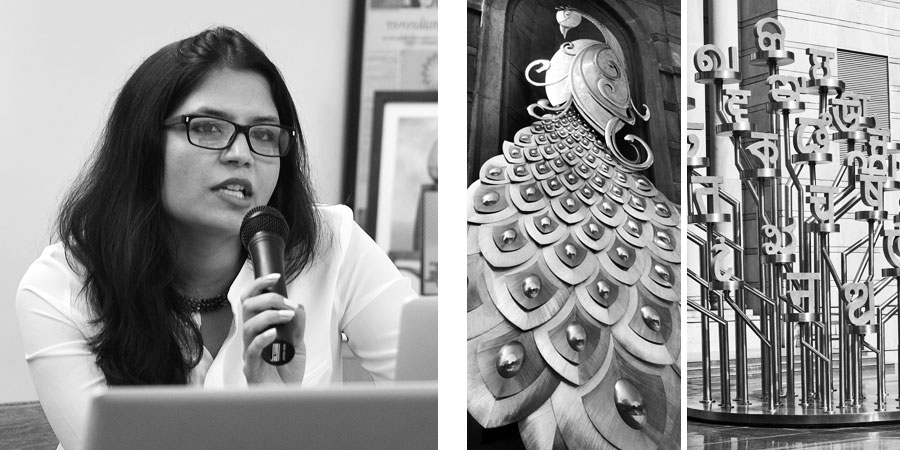
A master’s graduate in ‘Textile Futures’ from Central Saint Martins College of Art and Design, London and a post graduate in Textiles from NIFT New Delhi, Preksha Baid began her design studio Y-walls in New Dellhi in 2009. She conceived of Y-Walls as a creative place where the blend between traditional Indian crafts and interior design could be explored. Preksha’s efforts of bringing craft into contemporary spaces have won her great recognition. She constantly researches commercially viable ways of bringing sensory experiences through our rich tradition of craft and culture that are contextually relevant to the space.
The first presenter at the forum, Preksha’s work was detailed oriented and used many hand crafted techniques. The Ruby ceiling project was painstakingly beautiful, a crafted ceiling for the Park hotel in Hyderabad. The brief direction required that they use Kalamkari as a medium for the ceiling with an artistic approach for the hotel’s lounge. The project was also inspired by her grandfather’s house in Bikaner: in ancient times, people used artistic patterns and designs to decorate their ceilings. The project gave an opportunity for the craftsmen to continue their age old traditions and a new approach for space design.
Preksha has worked with the Indian Ministry of External Affairs for select projects. The ‘jewel peacock’, an art installation for the Ministry of External Affairs in New Delhi, represents the beautiful and intricate form of the national bird on the façade of a government building. As an artist, Preksha enjoys taking on challenging projects and tries to use interesting materials for the best outcome. For this project she used stainless steel, known to be one of the toughest material to work with.The project went through many iterations and took a while to find the right vendor to work with the material. The art installation came up wonderfully and gives the building an enriched Indian look.
A highly talented designer, Preksha likes to push herself to achieve unique and interesting solutions for her projects. In her experiments with different materials, she remains honest to her textile background. She has tried to discover the beauty of the corn leaf, a material highly ignored. She also worked to bring out various natural colors like tea, coffee and turmeric and special treatments in her products, always attempting to bring out the true nature of the material. We were able to see some of her samples at the Forum, many of which appeared very pleasing and unique.
Written by Ankita Singh
Deepali Saini, the first presenter at our forum, is a UX strategy expert. A practising design thinker, her specialities include User Experience Design, Innovation and Strategy, User Research, Design Process, Design Thinking and Innovation Management. After graduating from National Institute of Design in product design, she co founded Think Design Collaborative Pvt. Ltd in the year 2004 with two of her batch mates. Think Design’s USP is in aiding organizations become more user-centric. Their core services are in user experience design and industrial design.
At the Forum, Deepali presented select case studies of their past projects from the financial sector, mobile tv application and IT sector. Typically for any project, they study the target customer by segmenting them in various categories to understand them demographically and psychographically. They do persona mapping to study the customer journey map – what are their needs and how their behavior changes during various life journeys. This is not just of great use for designers but also for technology units, business process and infrastructure. The outcome helps them design communication strategy as well.
One particularly interesting approach centres around looking at scenario stories which are more event-centric and environment based. Deepali took the example of how a home loan seeker’s journey based out of rural India would be very different from that of a customer in an African country. In such cases, the scenario stories they create use visuals or basic illustrations to depict the customer’s environment. These culture and place specific journey maps help the key decision makers to build brand strategy and communication.
Deepali’s thorough knowledge of her subject with 12+ years of experience gave us wonderful insights about how context-specific studies help big brands understand their customers better. In the end, the customer is king.
Written by Ankita Singh
A master’s graduate in ‘Textile Futures’ from Central Saint Martins College of Art and Design, London and a post graduate in Textiles from NIFT New Delhi, Preksha Baid began her design studio Y-walls in New Dellhi in 2009. She conceived of Y-Walls as a creative place where the blend between traditional Indian crafts and interior design could be explored. Preksha’s efforts of bringing craft into contemporary spaces have won her great recognition. She constantly researches commercially viable ways of bringing sensory experiences through our rich tradition of craft and culture that are contextually relevant to the space.
The first presenter at the forum, Preksha’s work was detailed oriented and used many hand crafted techniques. The Ruby ceiling project was painstakingly beautiful, a crafted ceiling for the Park hotel in Hyderabad. The brief direction required that they use Kalamkari as a medium for the ceiling with an artistic approach for the hotel’s lounge. The project was also inspired by her grandfather’s house in Bikaner: in ancient times, people used artistic patterns and designs to decorate their ceilings. The project gave an opportunity for the craftsmen to continue their age old traditions and a new approach for space design.
Preksha has worked with the Indian Ministry of External Affairs for select projects. The ‘jewel peacock’, an art installation for the Ministry of External Affairs in New Delhi, represents the beautiful and intricate form of the national bird on the façade of a government building. As an artist, Preksha enjoys taking on challenging projects and tries to use interesting materials for the best outcome. For this project she used stainless steel, known to be one of the toughest material to work with.The project went through many iterations and took a while to find the right vendor to work with the material. The art installation came up wonderfully and gives the building an enriched Indian look.
A highly talented designer, Preksha likes to push herself to achieve unique and interesting solutions for her projects. In her experiments with different materials, she remains honest to her textile background. She has tried to discover the beauty of the corn leaf, a material highly ignored. She also worked to bring out various natural colors like tea, coffee and turmeric and special treatments in her products, always attempting to bring out the true nature of the material. We were able to see some of her samples at the Forum, many of which appeared very pleasing and unique.
Written by Ankita Singh
FOUNDER • DIFFERENTURE
Aakriti Kumar
FOUNDER • DIFFERENTURE
Aakriti Kumar
FOUNDER • DIFFERENTURE
Aakriti Kumar
FOUNDER • DIFFERENTURE
Aakriti Kumar
FOUNDER • DIFFERENTURE
Aakriti Kumar
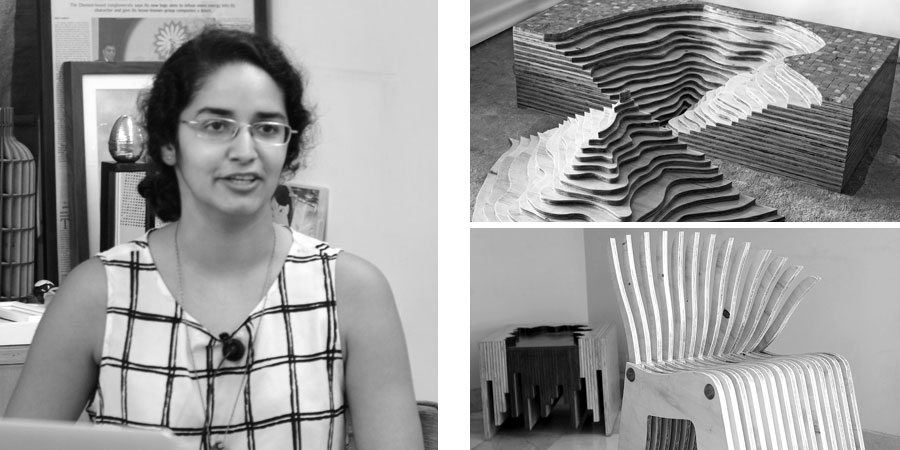
Aakriti Kumar, an alumnus of Parsons The New School for Design, New York, is a strong advocate of sustainability and sustainable product design. At the age of 24, Aakriti began Differenture, her own company in India. At the Forum, she took the audience through select furniture and lighting pieces designed at her firm, which showed us her different approach to design. Her pieces combine the beauty of art and sculpture with the functional approach of design – using salvaged wood from shipping containers, naturally fallen trees or trees that are interfering with the electricity cables. Aakriti believes that this kind of wood has a past life, and making furniture with all the imperfections (“perfections,” according to Aakriti) makes it all the more unique.
As a product designer, she has the strong belief that it is important to be sensitive to our environment. Every object we produce affects the environment in turn. Apart from sourcing materials from a sustainable point of view, she also uses non-toxic modes of finishing and polishing. It was truly inspiring to see this kind of deep commitment to sustainability when many organizations and people speak about being sustainable at a superficial level. A strong point of view and application of one’s beliefs while doing something they love is a mindset we increasingly see in many young entrepreneurs and designers. Aakriti shared her experience about working at a car company for sometime in Europe and how she concluded that it was something she did not want to pursue. This kind of decision making on her part created a sense of confidence in many people who attended the forum – that we can make our own informed choices.
Almost all Differenture’s products are made of exposed wood. Aakriti likes to let the material speak for itself and does not hide its natural beauty by covering the surface with a thick coat of paint. Today, many product and communication designers share similar points of view: that when materials speak for themselves, it is the best part. At her graduation ceremony, Aakriti Kumar had a choice between a regular tassel or a green tassel. The green tassel symbolized that graduates will follow sustainable design practices throughout their professional careers. You can guess which one she chose.
Written by Manav Dhiman
Aakriti Kumar, an alumnus of Parsons The New School for Design, New York, is a strong advocate of sustainability and sustainable product design. At the age of 24, Aakriti began Differenture, her own company in India. At the Forum, she took the audience through select furniture and lighting pieces designed at her firm, which showed us her different approach to design. Her pieces combine the beauty of art and sculpture with the functional approach of design – using salvaged wood from shipping containers, naturally fallen trees or trees that are interfering with the electricity cables. Aakriti believes that this kind of wood has a past life, and making furniture with all the imperfections (“perfections,” according to Aakriti) makes it all the more unique.
As a product designer, she has the strong belief that it is important to be sensitive to our environment. Every object we produce affects the environment in turn. Apart from sourcing materials from a sustainable point of view, she also uses non-toxic modes of finishing and polishing. It was truly inspiring to see this kind of deep commitment to sustainability when many organizations and people speak about being sustainable at a superficial level. A strong point of view and application of one’s beliefs while doing something they love is a mindset we increasingly see in many young entrepreneurs and designers. Aakriti shared her experience about working at a car company for sometime in Europe and how she concluded that it was something she did not want to pursue. This kind of decision making on her part created a sense of confidence in many people who attended the forum – that we can make our own informed choices.
Almost all Differenture’s products are made of exposed wood. Aakriti likes to let the material speak for itself and does not hide its natural beauty by covering the surface with a thick coat of paint. Today, many product and communication designers share similar points of view: that when materials speak for themselves, it is the best part. At her graduation ceremony, Aakriti Kumar had a choice between a regular tassel or a green tassel. The green tassel symbolized that graduates will follow sustainable design practices throughout their professional careers. You can guess which one she chose.
Written by Manav Dhiman
GRAPHIC BOOK DESIGNER
Rukminee Guha Thakurta
GRAPHIC BOOK DESIGNER
Rukminee Guha Thakurta
GRAPHIC BOOK DESIGNER
Rukminee Guha Thakurta
GRAPHIC BOOK DESIGNER
Rukminee Guha Thakurta
GRAPHIC BOOK DESIGNER
Rukminee Guha Thakurta
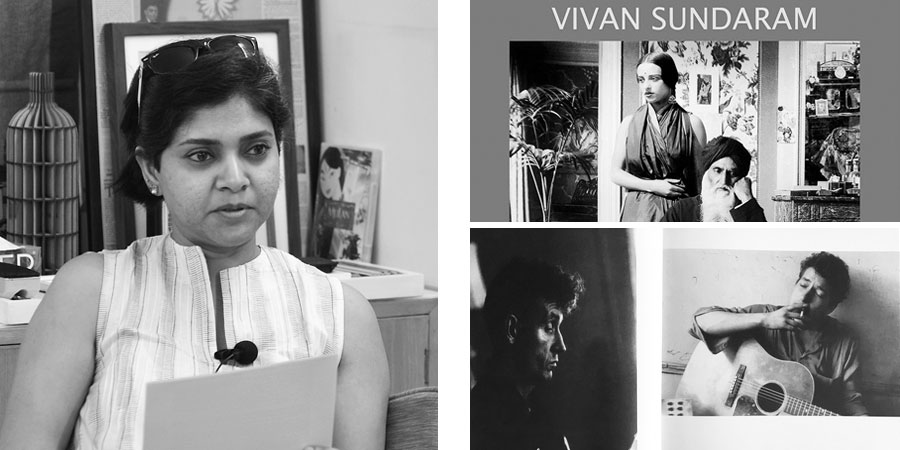
Rukminee graduated from the National Institute of Design in 2002 with specialization in Graphic Design. She has done print and book design, photobooks and magazines. She has worked with the Outlook Group and Steidl Verlag, Germany where she designed books for museums and artists. Instead of making a digital presentation, Rukminee read a well written document paraphrasing her journey.
Rukminee talked about her days in NID, how she was an unambitious sort and felt like a misfit. Instead of demoralizing her, the teachers there always encouraged her; eventually this led her to find her passion in book design. Reading her account, she spoke about the time she chose to work with print media over the lucrative digital media; she would make just about enough to survive but was satisfied with the work. Rukminee wears several hats in the most prosaic way. She does not believe in making plans, her last plan being studying at NID. She spoke about how she briefly worked under Orijit Sen, whose work inspired her immensely in the Virasat-e-Khalsa project. Another project she shared was the documentation of the crafts of Chhattisgarh for the book ‘Crafts of India’. Rukminee recently curated Zones of Privacy, possibly the first of its kind show in India of artists’ notebooks and sketchbooks, where we get more than a glimpse into their personal thoughts and explorations.
Rukminee believes in taking life as it comes, remaining behind the scenes, taking it slow, without plans, going with the flow, yet remaining extremely efficient: this approach has helped her do exceptionally well in her chosen path. Design is her way of life.
Written by Aseem Arya
FOUNDERS • POOCHKI
Ishanee and Anirudh
FOUNDERS • POOCHKI
Ishanee and Anirudh
FOUNDERS • POOCHKI
Ishanee and Anirudh
FOUNDERS • POOCHKI
Ishanee and Anirudh
FOUNDERS • POOCHKI
Ishanee and Anirudh
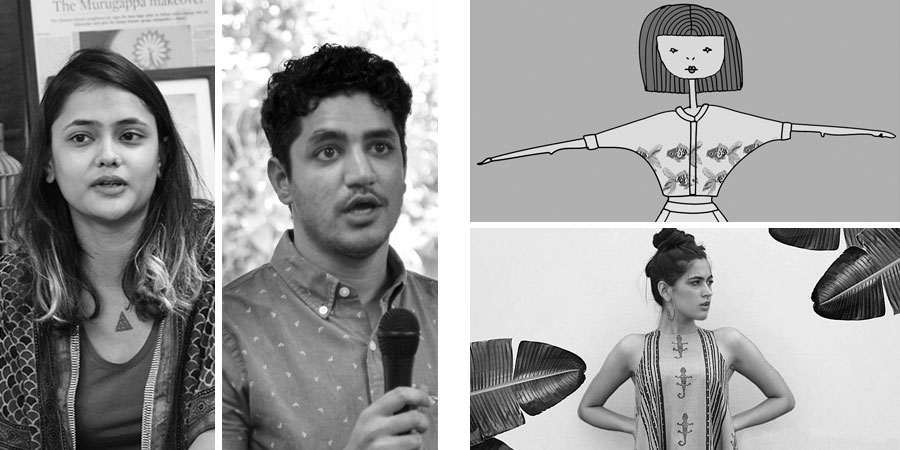
Bored with his regular job over 8 to 9 years, hotelier Anirudh Chawla launched a clothing label along with Ishanee Mukherjee, a textile designer from NIFT. Chawla’s brainchild Poochki has its curious name inspired by Ishanee’s tail-less manx who her mother fondly called “Pooch kati.”
Right from carving forms out of wooden blocks to printing, every garment created at Poochki comes with a unique narrative. The USP of the brand is such that each piece of apparel has a story which is backed up by a well thought process of block making, dyeing, printing and weaving. Simultaneously, the label sports an innovative and ingenious look and feel. While Ishanee and Anirudh use traditional fabrics, the cuts, silhouettes and prints add an extremely modern touch to the garments. Poochki aims to cater to women across all age groups looking for a high quality range of casual and comfortable garments.
We found two specially interesting aspects about their work. One, instead of following the traditional route of picking up blocks of the butti and butta shape, Ishanee and Anirudh derive their inspiration from flora and fauna we are surrounded by in our lives. Geckos, wasps, hedgehogs and fish are all subjects for the blocks they carve out inspired by these forms. The other notable aspect of their designs is that they resonate with the lifestyle changes that are taking place in today’s world. In a market where a woman is made to feel embarrassed asking for a larger size, it makes perfect sense to provide a range of clothing that is anti fit.
The young Indian woman is increasingly becoming open to accepting the imperfections of her body and willing to project herself the way she is and be proud of it. Pookchi has responded to these changes and built their label with bravado, in the choice of cut, motifs, patterns and print.
Written by Ruma Dhingra
HUMANITIES & SOCIAL SCIENCES EXPERT
Raj Ayyar
HUMANITIES & SOCIAL SCIENCES EXPERT
Raj Ayyar
HUMANITIES & SOCIAL SCIENCES EXPERT
Raj Ayyar
HUMANITIES & SOCIAL SCIENCES EXPERT
Raj Ayyar
HUMANITIES & SOCIAL SCIENCES EXPERT
Raj Ayyar
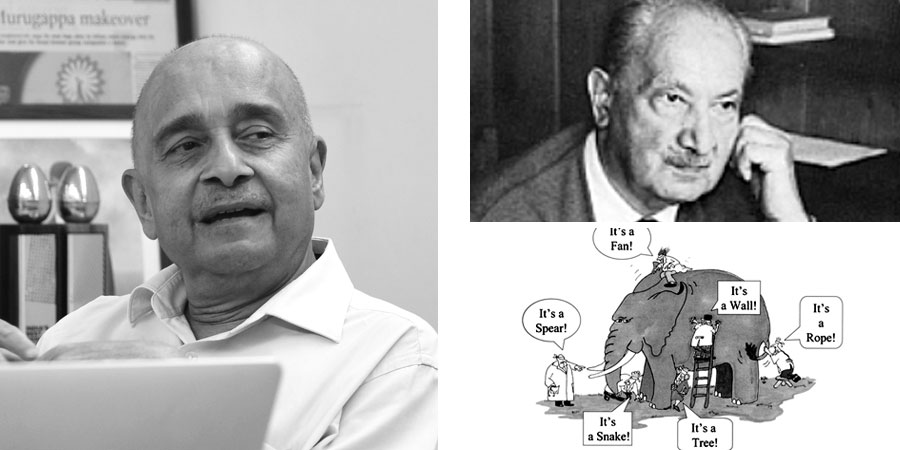
Raj Ayyar is a full time visiting professor in the humanities and social sciences at IIT Delhi. Raj’s teaching experience spans more than 20 years in the humanities. His areas of interest are in Philosophy of Literature, Philosophy of Religion, Critical and Creative Thinking, Service-Learning, Multicultural Studies and Gender Studies. His corporate experience is wide-ranging as Corporate Consultant Trainer, Personality Development, Cross-Cultural Diversity, Stress Management and Work-Life Balance for companies such as Wipro, Sonata Software, Barry-Wehmiller and others. Raj firmly believes in experiential education and is committed to a dialogic, fully engaged classroom, with a cross-disciplinary emphasis in teaching courses and training programs.
Raj Ayyar was the fourth to present at our Forum. His holistic viewpoint to critical and creative thinking came through in intriguing and thought-provoking topics. The audience was enlightened to perceive the world in fresh ways. Raj spoke about everydayness, where people get entangled in their daily lives and forget to think beyond. His simple suggestion that every morning we scribble down our thoughts to clear our mental blocks helps to question ourselves and adopt new ways of doing things – by breaking the mundane and the obvious.
Raj pointed out how every individual has a different perception of the world and it is important to remember that there is nothing wrong or right in having varying perspectives. He expanded on “PO thinking”, a very interesting way of thinking beyond. Most of us stick to Yes and No – instead, could we think of PO i.e. more possible options? By choosing this path in both our personal and professional life, one may learn how to approach situations very differently.
He also spoke about stereotypes, a universal ugly truth – how people habitually judge others without really getting to know them. People rush to stereotype and look down upon others – sometimes on racial and religious grounds – thus shelving themselves and avoiding conversations. By this, we close the window that opens the vista to know another as we have already categorized them in mental boxes. An open and receptive attitude to other viewpoints, can avoid this kind of compartmentalizing.
All the topics Raj spoke made the audience think about their behavior patterns. The session was wonderful and very refreshing. We definitely wish to invite Dr Raj for more such enriching sessions.
Written by Ankita Singh
TEXTILE DESIGNER & FIBER ARTIST
Gopika Nath
TEXTILE DESIGNER & FIBER ARTIST
Gopika Nath
TEXTILE DESIGNER & FIBER ARTIST
Gopika Nath
TEXTILE DESIGNER & FIBER ARTIST
Gopika Nath
TEXTILE DESIGNER
& FIBER ARTIST
Gopika Nath
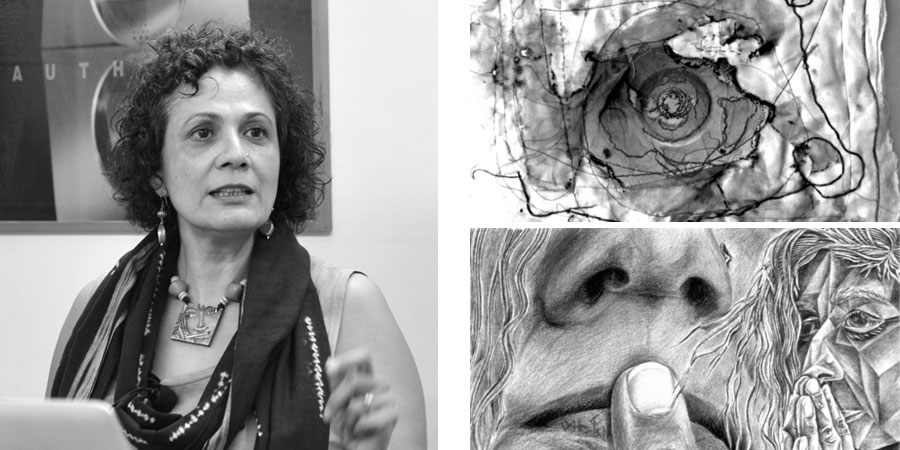
An alumnus of the Central School of Art and Design, London, U.K, textile designer Gopika Nath eventually evolved into a textile artist as well as a writer and teacher. Gopika believes that Textile Art is a key element in defining the future of India’s hand-crafting legacy. “I am inspired to embroider, rather than paint on canvas. Working with needle and thread, exhibiting my work as an artist/ craftsperson in the environs of the Art Gallery, I hope to be able to lend dignity to the notion of hand-crafting as ‘Art’, elevating it beyond mere skilled labour, as it is largely considered today”.
During her early days of working as a textile designer, Gopika was inspired by forms in the environment and tried bring in those elements through her weaving style. She then started designing saris. Soon she realized the craftsperson was not enabled to transform what she was imagining into reality, due to restrictions of traditional techniques of printing. Thus began Gopika’s journey of exploration to reach a milestone that she will always be known for, i.e. bringing hand painted saris to India. Working in this manner gave her immense freedom and became a form of her expression. However, her journey was not easy as we are in an era where hand crafted goods are no longer valued. At one juncture, one of her clients reinforced this need for struggle – how artists must suffer before they triumph – giving succour to Gopika’s chosen path.
Gopika’s presentation was special for the way it spoke about her work – which has very strong character – and the manner in which we could experience her journey through time. In her work, one sees the courage to express positive as well as negative states of minds through art. Very clearly, her presentation recapitulated her journey from a designer to an artist. Gopika recalled how she went back to the drawing board for two years to derive inspiration for her embroidery. Gradually, she found her ideation in the complexities of her own mind reflected through mundane objects. Symbolic expressions such as the piercing needle is expressed in her works. Another recent exploration of hers is a series of artworks created from stains left by tea, making impressions about the imperfections and complexities of human life. Gopika’s work is extremely courageous and she does not shy away from showcasing the truth through her art. As she says, “We are 85 percent water and water is supposed to flow; why then should we not be allowed to flow like an ocean and let ourselves be comfortable with our imperfections and flaws?”
Written by Ruma Dhingra
FOUNDER • COLLECTIVE CRAFT
Sibanand Bhol
FOUNDER • COLLECTIVE CRAFT
Sibanand Bhol
FOUNDER • COLLECTIVE CRAFT
Sibanand Bhol
FOUNDER • COLLECTIVE CRAFT
Sibanand Bhol
FOUNDER • COLLECTIVE
CRAFT
Sibanand Bhol
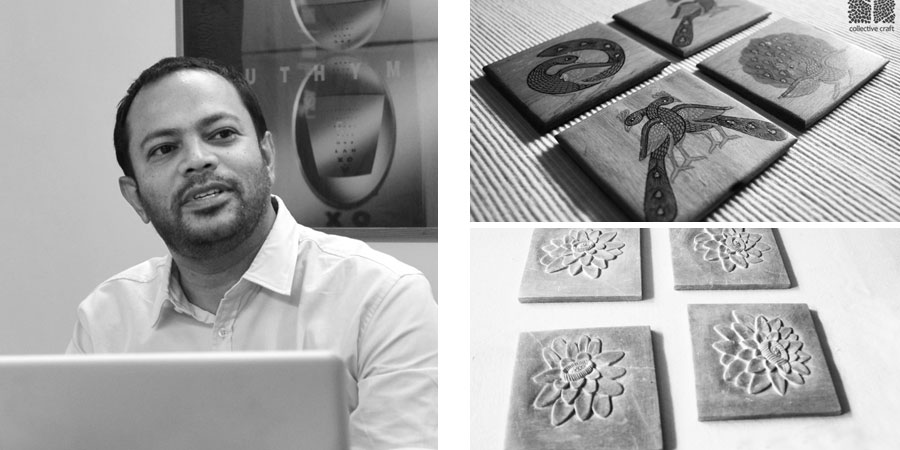
An architect from School of Planning and Architecture, New Delhi, Sibanand Bhol passed out in 2001. Sibanand worked for a few years in the field before he started his own set-up with a graduate from NID, Shweta Mohapatra. They envisioned Collective Craft, a collaborative of Architects, Designers and Artisans, working together towards promoting customized and handcrafted design applications.
Sibanand talked about how artisans work in isolation and this can be difficult for their progress. The challenge lies in finding ways to integration. Based out of Bhubaneshwar in Odisha, Collective Craft tries to bring together craftsmen from various parts of India to come up with shared skills. These collaborations take place at their residential school. Initially, the collective concentrated on projects that involved making products and one was at Krishi Bhawan, Ministry of Agriculture, Government of Odisha. Amongst a series of installations, the ‘farmer’s calendar’ was very special as it made connections with agricultural practice. Most crafts people work as part time farmers and this is a visual calendar with a festival associated with each month that depicts a farmer’s life over the course of the year.
From their initial work in making products, the group moved to doing architecture. The studio hosts skilled people like brick masons and carpenters as these skill-sets are also facing a crisis with the advent of modern construction techniques. Sibanand stressed on practical issues like the unavailability of raw material and how this affects poor craftspersons. In their architectural projects, the collective is specifically trying to revive the vernacular construction style.
Written by Aseem Arya
LANDSCAPE & ARCHITECTURE
Gaurav Kapoor
LANDSCAPE & ARCHITECTURE
Gaurav Kapoor
LANDSCAPE & ARCHITECTURE
Gaurav Kapoor
LANDSCAPE & ARCHITECTURE
Gaurav Kapoor
LANDSCAPE &
ARCHITECTURE
Gaurav Kapoor
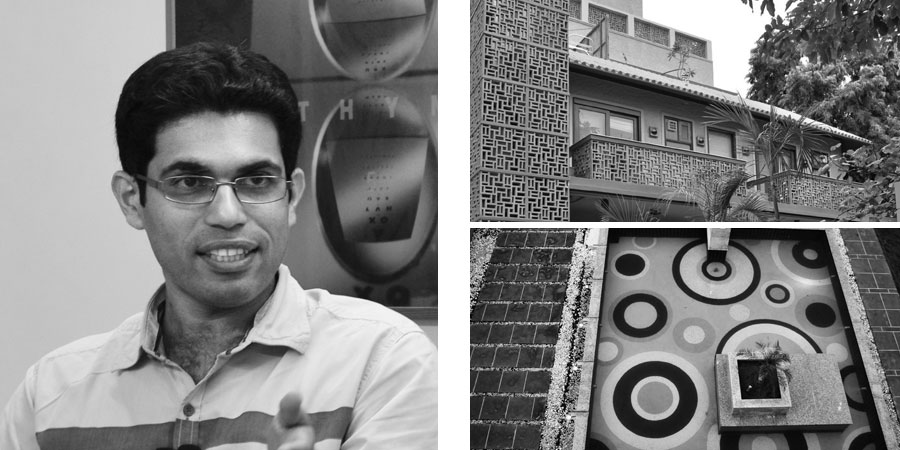
Gaurav Kapoor and his wife Neha Bhardwaj form the core team at their architectural design practice, Layers Studios. Gaurav presented their work through different facets of architectural design such as [Context], [Materials], [Lighting], [Art] etc. covering projects in a non linear manner. While the projects ranged from hospitality to residential, one that generated a lot of interest, was a resort in Rishikesh called Aloha on the Ganges. Artist Gopika Nath, also a presenter that day was especially appreciative of this project, which was significantly context driven.
The restaurant, lodging, an infinity pool and other spaces were built at various levels working around site conditions. Large stones were not removed, instead the spaces were designed around them. The location of the Infinity pool was selected at site rather than making the decision on the drawing board. After making multiple visits over many seasons, the architects found the vantage point that would capture the perfect view over the infinity edge. This can easily be seen as the USP of the project. Other residential projects in Udaipur and Noida involved looking at the true nature of materials to develop the design and also work closely with local artisans in design development and execution.
The architects also enjoy working with light and shadow to bring a unique character into spaces. Often in renovation or adaptive reuse projects, the duo tries to salvage what comes out from the existing site, or other unused items, to turn it around into art installations. Looking at the overall approach towards these multiple aspects of design was refreshing and inspiring.
Written by Anshul Kapoor
CEO & PRINCIPAL DESIGNER
Anthony Lopez
CEO & PRINCIPAL DESIGNER
Anthony Lopez
CEO & PRINCIPAL DESIGNER
Anthony Lopez
CEO & PRINCIPAL DESIGNER
Anthony Lopez
CEO & PRINCIPAL DESIGNER
Anthony Lopez
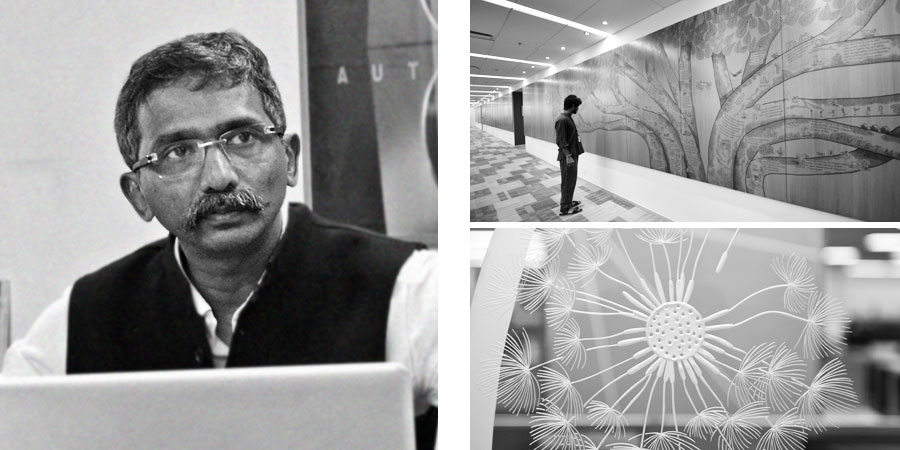
Anthony is the founder of Lopez Design, established in 1997 as a multidisciplinary communications and branding firm. At our monthly Forum, Anthony usually makes a presentation at the end about what our design studio is all about and shares the journey of one major project done by our studio. This time, Anthony had two presentations to make.
The first one was about his journey as a child from Ahmedabad to who he is today and certain milestones that shaped him not only as a designer but as a person. His father was a block-maker at NID, and Anthony spent many days of his childhood in the printing department at the Institute. Consequently, he knew NID inside out, much before he joined as a student. After completing the program, he worked at an advertising firm for 6 months. Very soon, he decided to start his own practice. It was captivating to hear Anthony’s story from his initial start-up with a peer group from NID to his successful entrepreneurial efforts with Lopez Design, his own studio. The room was filled with a sense of awe after he ended his story. For those who had just started on their career paths, it was an eye-opening experience to hear about how he overcame his challenges.
Anthony’s second presentation was one of several major environment branding projects that Lopez Design has done for Mercer. Lopez Design’s approach towards branding environments is not to simply project the company’s logo and corporate colours on the walls of its offices; it is a deep conceptual exercise into understanding what a particular organization’s ideals are and what motivates its employees. For Mercer Noida, the concept of the Tree of Life was chosen. This involved making mammoth illustrations etched on wood spanning entire walls of 3 floors of the office space. The rationale behind this was how to break away from feeling that as an employee of a multinational company you are just “one of the two thousand”. The challenge therefore was how to make each employee feel, where he sat was special. He was not just a number, he was just not sitting at desk number 1539 – he was a person with his own unique space near the root of the Mercer Tree.
The concept was amazing, and brought a completely different perspective to what branding an office space feels like!
Written by Manav Dhiman
Activation
Project Management
Supervision
Fabrication & Installation
© 2025 Lopez Design Pvt. Ltd. All rights reserved