
Forum No.13
4th Feb 2017
Forum No.13
4th Feb 2017
Forum No.13
4th Feb 2017
Forum No.13
4th Feb 2017
Forum No.13
4th Feb 2017
COLLABORATION | SOLVES CASES
COLLABORATION | SOLVES CASES
COLLABORATION | SOLVES CASES
COLLABORATION | SOLVES CASES
COLLABORATION | SOLVES CASES
ORGANIC AMBASSADOR
Ashish Gupta
DOCUMENTARY PHOTOGRAPHER
Ahmer Khan
DIRECTOR • PSI ENERGY
Gaurav Shorey
TEXTILE DESIGNER • SWATIKALSI
Swati Kalsi
ORGANIC AMBASSADOR
Ashish Gupta
DOCUMENTARY PHOTOGRAPHER
Ahmer Khan
DIRECTOR • PSI ENERGY
Gaurav Shorey
TEXTILE DESIGNER • SWATIKALSI
Swati Kalsi
ORGANIC AMBASSADOR
Ashish Gupta
DOCUMENTARY PHOTOGRAPHER
Ahmer Khan
DIRECTOR • PSI ENERGY
Gaurav Shorey
TEXTILE DESIGNER • SWATIKALSI
Swati Kalsi
ORGANIC AMBASSADOR
Ashish Gupta
DOCUMENTARY PHOTOGRAPHER
Ahmer Khan
DIRECTOR • PSI ENERGY
Gaurav Shorey
TEXTILE DESIGNER • SWATIKALSI
Swati Kalsi
ORGANIC AMBASSADOR
Ashish Gupta
DOCUMENTARY PHOTOGRAPHER
Ahmer Khan
DIRECTOR • PSI ENERGY
Gaurav Shorey
TEXTILE DESIGNER • SWATIKALSI
Swati Kalsi
ARTIST
Alka Mathur
ILLUSTRATOR • CHOORMA
Shikhant Sablania
ARTIST
Orijit Sen
ARTIST
Alka Mathur
ILLUSTRATOR • CHOORMA
Shikhant Sablania
ARTIST
Orijit Sen
ARTIST
Alka Mathur
ILLUSTRATOR • CHOORMA
Shikhant Sablania
ARTIST
Orijit Sen
ARTIST
Alka Mathur
ILLUSTRATOR • CHOORMA
Shikhant Sablania
ARTIST
Orijit Sen
ARTIST
Alka Mathur
ILLUSTRATOR • CHOORMA
Shikhant Sablania
ARTIST
Orijit Sen
ORGANIC AMBASSADOR
Ashish Gupta
ORGANIC AMBASSADOR
Ashish Gupta
ORGANIC AMBASSADOR
Ashish Gupta
ORGANIC AMBASSADOR
Ashish Gupta
ORGANIC AMBASSADOR
Ashish Gupta
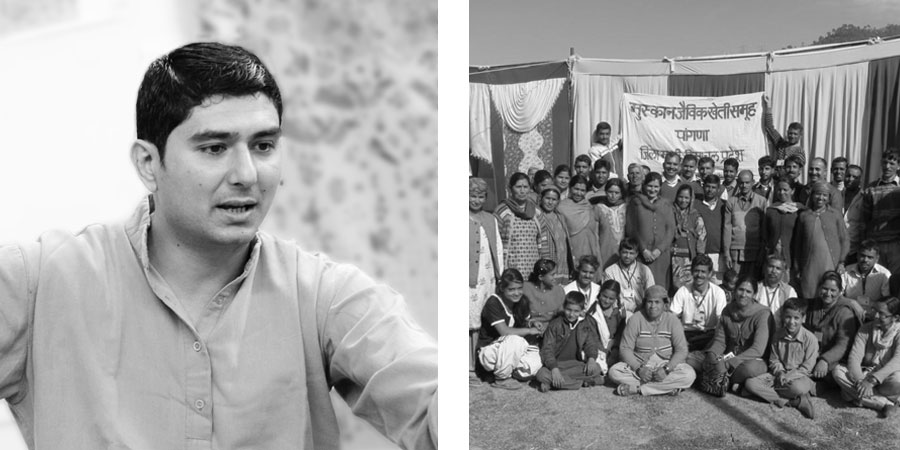
Ashish Gupta has been working for the past 8 to 9 years with small and marginal farmers across India. He works mostly with rain fed farmers who do not have irrigation facilities and are dependent on the weather. His initiative called “Muskaan” has been an attempt to create value for organic farmers. At the forum, Ashish shared how the word “organic” is an imported word and we try to Indianise it. He questioned this and said that we are trying to rediscover something that has always been there. He shared how we need a farmer three times a day, more than a doctor or a lawyer, yet we do not have a platform or forum to know them.
Gupta’s farmer center, “Jaivik Farm” is based in Pangna under Mandi District, which is 100km north to Shimla. Many foreigners, for instance German volunteers, have been willing to come and work there, but no Indian students have shown an interest. He has initiated a “volun-tourism” where visitors are given an opportunity to work on the farmer’s fields to experience ecological farming, work on rural crafts with blacksmiths, potters and weavers.
The “Jaivik Haat” is a store which was started in Delhi to give an opportunity for farmers to sell. They regularly do pesticide and agro-chemical testing, but Delhi is a tough market for organic food. Gupta feels he is catering to an undeserving clientele in Delhi, as Delhites keep demanding the best and cheapest at the expense of the farmer. The charges are based on true cost and not in response to market pressures. The attempt has been to create a short supply chain with transparency, where everyone in the chain is made aware of the origins. Consumers know the source as well as farmers knows the price at which its being sold. The challenge was taken to purposefully put up the store in a middle class suburb of North Delhi – it would be worth it only if it could survive in such a space. Gupta has been proven right. Now for eight years, the organization has been running without debt, and the generation of funds is only through cash flows (without any support from any NGO or govt.). The farmers trade only surplus. The first market is always local i.e. the farmer’s own village, then the neighbouring villages and only the surplus reaches Delhi.
Now, attempts are being made to build sustainable building systems for rural toilets, animal shed and rural community kitchen. Training sessions are held on hand held tools, and the focus has been to ensure that there is no increase in the input cost to the farmer. Gupta has also been running safe food campaigns in schools for the last three years. Aside of organic farming, his efforts have also been sizeable to revive and preserve stone masonry, traditional pottery, blacksmiths and weavers, volunteerism and exchange programmes.
Written by Deekshit Sebastian
Ashish Gupta has been working for the past 8 to 9 years with small and marginal farmers across India. He works mostly with rain fed farmers who do not have irrigation facilities and are dependent on the weather. His initiative called “Muskaan” has been an attempt to create value for organic farmers. At the forum, Ashish shared how the word “organic” is an imported word and we try to Indianise it. He questioned this and said that we are trying to rediscover something that has always been there. He shared how we need a farmer three times a day, more than a doctor or a lawyer, yet we do not have a platform or forum to know them.
Gupta’s farmer center, “Jaivik Farm” is based in Pangna under Mandi District, which is 100km north to Shimla. Many foreigners, for instance German volunteers, have been willing to come and work there, but no Indian students have shown an interest. He has initiated a “volun-tourism” where visitors are given an opportunity to work on the farmer’s fields to experience ecological farming, work on rural crafts with blacksmiths, potters and weavers.
The “Jaivik Haat” is a store which was started in Delhi to give an opportunity for farmers to sell. They regularly do pesticide and agro-chemical testing, but Delhi is a tough market for organic food. Gupta feels he is catering to an undeserving clientele in Delhi, as Delhites keep demanding the best and cheapest at the expense of the farmer. The charges are based on true cost and not in response to market pressures. The attempt has been to create a short supply chain with transparency, where everyone in the chain is made aware of the origins. Consumers know the source as well as farmers knows the price at which its being sold. The challenge was taken to purposefully put up the store in a middle class suburb of North Delhi – it would be worth it only if it could survive in such a space. Gupta has been proven right. Now for eight years, the organization has been running without debt, and the generation of funds is only through cash flows (without any support from any NGO or govt.). The farmers trade only surplus. The first market is always local i.e. the farmer’s own village, then the neighbouring villages and only the surplus reaches Delhi.
Now, attempts are being made to build sustainable building systems for rural toilets, animal shed and rural community kitchen. Training sessions are held on hand held tools, and the focus has been to ensure that there is no increase in the input cost to the farmer. Gupta has also been running safe food campaigns in schools for the last three years. Aside of organic farming, his efforts have also been sizeable to revive and preserve stone masonry, traditional pottery, blacksmiths and weavers, volunteerism and exchange programmes.
Written by Deekshit Sebastian
DOCUMENTARY PHOTOGRAPHER
Ahmer Khan
DOCUMENTARY PHOTOGRAPHER
Ahmer Khan
DOCUMENTARY PHOTOGRAPHER
Ahmer Khan
DOCUMENTARY PHOTOGRAPHER
Ahmer Khan
DOCUMENTARY PHOTOGRAPHER
Ahmer Khan
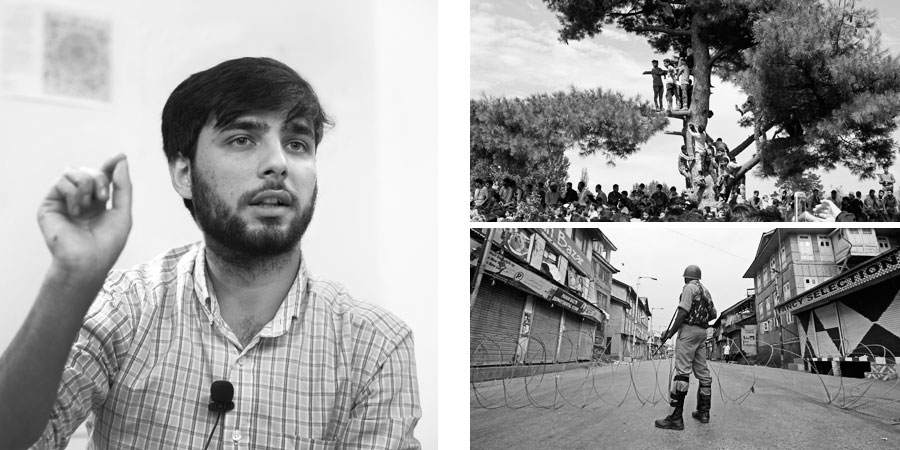
Ahmer Khan is an independent documentary photographer based in Srinagar, Kashmir. His work has been published in AlJazeera, BBC, Getty Images, The Guardian, Carnegie Council, Foreign Policy, Vice News, BuzzFeed, The Diplomat, Metro.co.uk and many other publications. He was previously working for World Health Organization during the Nepal earthquake and continues to contribute to The Christian Science Monitor, Anadolu Agency & Radio France International covering South Asia.
The second speaker at our February Forum, Ahmer presented the audience many of his prominent projects, which he has covered over the years. The presentation began with the black and white series of Burhan Wani’s funeral. The images were very powerful and gripping, representing the true sentiments of the people of Kashmir. Hundreds of people gathered to mourn his death, evidently one of the biggest gatherings for a funeral in Kashmir.
Ahmer also runs LoudBettle, a start up for events management. The main objective of the company is to promote and encourage the youth of Kashmir, providing them hubs & facilities. They organized one of the biggest art shows of Kashmir in one of the galleries in Delhi, to raise funds for the Kashmir flood victims. They hosted Asia’s longest ifitaar, which was 1.6 km long and accommodated about 3000 people. To organize these events they received a lot of support from the people and the government.They have also conducted film festivals, Bollywood concerts, food festivals and night market.
Over the years Ahmer has worked on many projects, he presented his work on the rural olympics which is held in Ludhiana, the school under the Yamuna bridge and the refugee community in Delhi. Last year, he covered the Nepal earthquake aftermath, concentrating specifically on the story of children after the 4th day of the earthquake – the project was commissioned by VICE News. Ahmer talked about the recent issue of banning the pellet gun. His series showed heart-rending images of many young victims who lost one or both the eyes due to use of the pellet gun. In a war stricken environment where tensions between the police and the people is a normal affair, Ahmer is an icon amongst the youth and knows how to keep smiling.
Written by Ankita Singh
DIRECTOR • PSI ENERGY
Gaurav Shorey
DIRECTOR • PSI ENERGY
Gaurav Shorey
DIRECTOR • PSI ENERGY
Gaurav Shorey
DIRECTOR • PSI ENERGY
Gaurav Shorey
DIRECTOR • PSI ENERGY
Gaurav Shorey
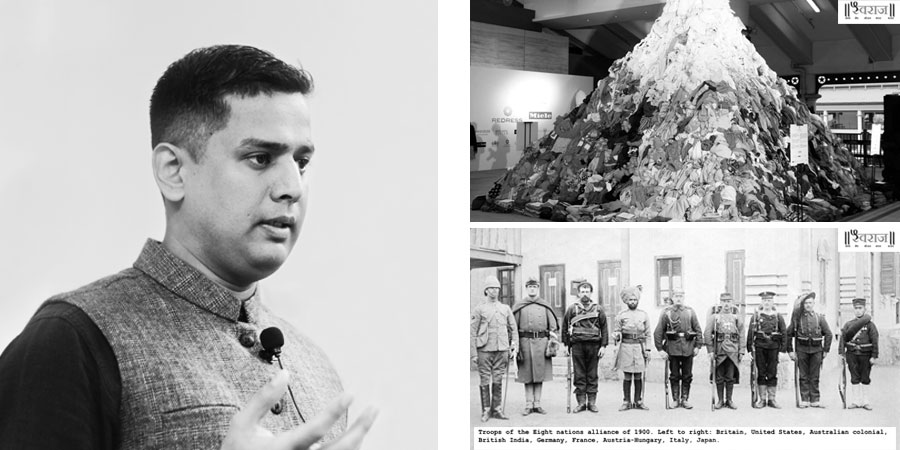
“NOTHING… in this presentation is true”. Gaurav Shorey began with this dramatic statement, keeping us on the edge of our seats for the rest of his presentation.
Gaurav is an architect and heads PSI, a sustainable design studio in Delhi. We were expecting a rudimentary presentation on sustainability, the kinds all architects dealing with such issues usually share. What followed took us by surprise. Gaurav’s presentation was about a parallel program called “5waraj” that he conducts in various organisations and institutions. 5waraj aims to sensitise participants towards the idea of sustainability.
The presentation was beautifully composed as a narrative to explain how we are in fact not being “sustainable” by depending on technology that again uses energy to give us a false notion of sustainability. Interesting and informative as it was, the presentation is dumbed down to a level that concepts become clear and easy to understand for laypersons. Through his participatory conversation during the presentation, interspersed with occasional jokes, Gaurav engaged with us so that we could understand the logic behind the idea of sustainability.
Building a sustainable environment is as easy as going back to our roots. Our current way of life takes us to various parts of the world in alien environments, climate, food, culture, traditions, dance, music, language and so on. Wherever our body feels displaced, it constantly makes attempts to adapt itself to unfamiliar situations and in many cases with generic manmade environments. There is a reason why people in hot climates have a particular kind of clothing and the houses built with local materials. Procuring food locally available and preparing it in a certain way serves a purpose. Culture and traditions also co-relate to the geographical location on the planet.
We definitely cannot go back to the more primitive ways of living (unless we voluntarily choose to do so), and detach ourselves from the current trends all of which demands a certain quality of life. But having an understanding and awareness of the traditional concepts that evolved logically and not because of the lack of technology can surely help us move forward with a sound interpretation of the term “sustainability”.
So how can we be sustainable? Gaurav ended his presentation by saying that “It is ok to be local”. He encouraged us to be “Indian”, cook and eat our local food, speak our local languages. We were all hooked to these ideas presented in one of the most dynamic presentations we were lucky to witness.
Written by Surajit Ranjan Das
TEXTILE DESIGNER • SWATIKALSI
Swati Kalsi
TEXTILE DESIGNER • SWATIKALSI
Swati Kalsi
TEXTILE DESIGNER • SWATIKALSI
Swati Kalsi
TEXTILE DESIGNER • SWATIKALSI
Swati Kalsi
TEXTILE DESIGNER • SWATIKALSI
Swati Kalsi
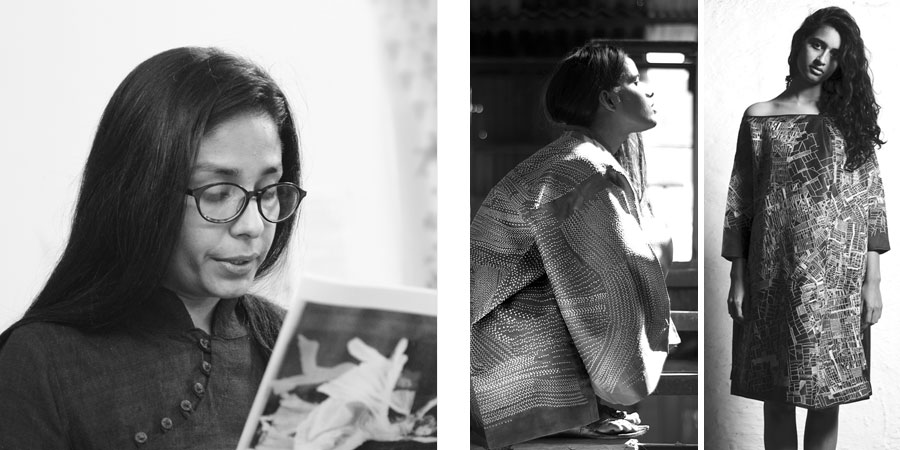
Swati Kalsi is a textile designer from Delhi. Her expertise lies in Sujani embroidery, a craft from Bihar. According to records, Sujani embroidery has existed from the 1920s and the credit for keeping the craft alive goes to Bihari women. Sujani is a special quilt made from recycled sarees using a running stitch. This technique which involves stitching together pieces of old fabric has a belief system behind it. The cloth bound together by Sujani served a ritual function. It invoked Chitriya Ma, the lady of the tatters. ‘Su’ means facilitating and ‘Jani’ means birth. Hence, it is used to wrap a newborn baby. It is also preferred because old cloth is softer and feels closest to a mother’s womb.
During her presentation, Swati spoke about how needle work embroidery has been a woman’s expression of identity- working with thread is a way of life and way of expression for people with dextrous hands. Swathi spoke about how fabrics used in different places tell us about their geo-climatic conditions. The techniques speak of the level of the civilization. The motifs tell us about their legends and myths, beliefs and also their way of life. Embroidery created by women is all this and yet, more. Embroidery is fundamental to the women, like an emblem.
Rather than just being expressions of their creativity, sujani quilts are pieces of art that can be used. Swathi spoke about how poverty, exploitation and tempting jobs in cities are making the youth leave their rich tradition behind for something very ordinary and mundane. What could bring this back? Swati brought her passionate argument for how Sujani techniques along with new designs ought to come back in the market.
Written by Agnisesh Setlur
ARTIST
Alka Mathur
ARTIST
Alka Mathur
ARTIST
Alka Mathur
ARTIST
Alka Mathur
ARTIST
Alka Mathur
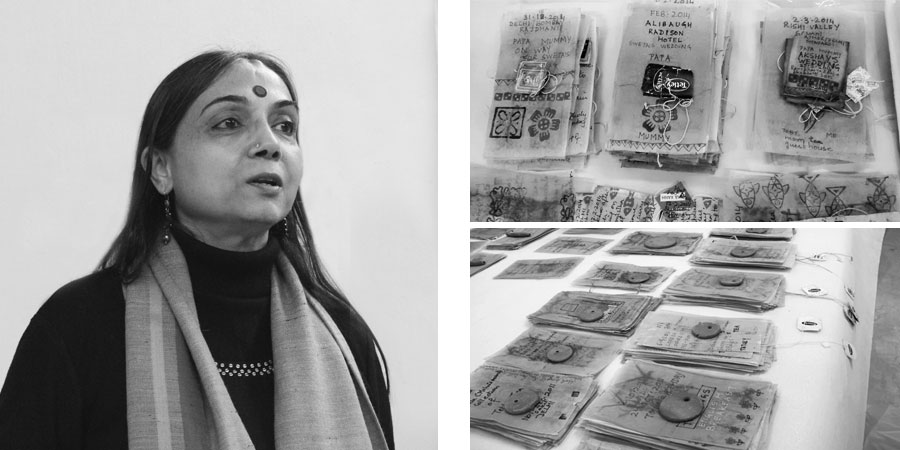
Alka Mathur, the fifth presenter at our February Forum is a mixed media artist. She works with natural dyes, kantha stitching, tea bags and found objects to make assemblages and art works. Since childhood Alks has been collecting memorabilia to mark time, place and events. It comes naturally to her as her grandfather and mother had similar passion for art and love for nature. Born in Rajasthan and with the influence of her roots her initial paintings took from the Rajasthani culture, especially the colors.
Over the years she has collected seeds, dried flowers and leaves, stones and shells, metallic and other found objects, which is a part of her studio and home. Her collection also includes hand crafted birds, tea pots and kettles. She is a person who gets inspiration from visuals; she loves to click pictures of textures and patterns of nature, the sky, birds, clouds, sun and the moon. Often these are from the windows of her home or while traveling from an aircraft or car. During the presentation we saw some of her collections and it was wonderful to see how well she has managed to keep her collection intact.
She feels little things matter in life and it is one’s choice how and what they want to experience. This led to her venture and experiments with tea bags, which is an amazing metaphor for capturing a moment. She has collected thousands and thousands of tea bags and the artwork that she has created was by fusing, burning, writing, stitching, collaging and stamping on them. The outcome of these fusions is a visual treat leading to multiple interpretations.
Alka paints for her own pleasure and enjoyment and as a true artist the sheer joy of creating keeps her going. The audience loved her work and it was truly inspiring to see her dedication and passion towards her work.
Written by Ankita Singh
ILLUSTRATOR • CHOORMA
Shikhant Sablania
ILLUSTRATOR • CHOORMA
Shikhant Sablania
ILLUSTRATOR • CHOORMA
Shikhant Sablania
ILLUSTRATOR • CHOORMA
Shikhant Sablania
ILLUSTRATOR • CHOORMA
Shikhant Sablania
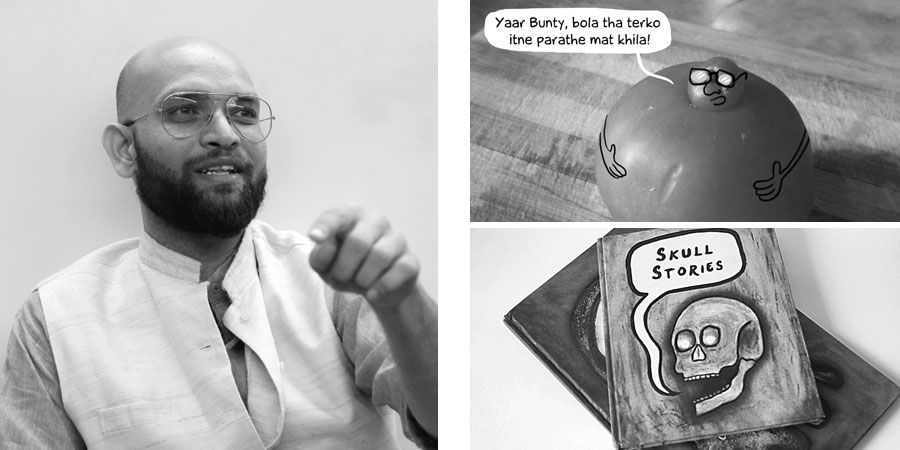
Shikhant aka the Choorma is a self taught artist who works with varied media. He paints, illustrates, draws comics and practices graphic design as well. He draws whatever is funny for himself. Primarily a surrealist, Shikhant derives inspiration from the ironies of life that people tend to overlook, the things that matter in today’s context, stories around him and his personal experiences. He likes combining inanimate objects with living matter to create a new meaning and/or a story and prefers to keep it raw.
Shikhant started out by drawing science fiction comics. He showed us one of his first comic panels done on a ruled sheet of paper using stick figures for humans. Shikhant was in class 8 back then. His inspiration since then has been Jules Vernes. Shikhant would spend his spare time coming up with stories two friends would get together and create a wacky machine, aliens would invading the earth or re-doing the periodic table according to his preferences.
By the time he reached class 11 the Indian education system had taken over his life and he got lost in the world of transistors, transformers and mechanics. By the last year of college Shikhant realised that there was a disconnect from his life and engineering. He started questioning what he will use out of engineering in his life and came up blank. This disconnect was the trigger to the beginning of his career as an illustrator. To understand what will help him connect to life he started doing everything away from engineering, which was creating murals, posters and graphics.
After college got over the biggest question came to him: How do you become an artist? And the realisation that there is no formula. Shikhant started hitchhiking across the country. During that journey something grew within him; something, which he can’t point out. Soon after he adopted his pen name “the Choorma” and started collaborating with other illustrators on comics and books. One of his first collaborations were a zine.
The Delhi Comic Kala Samagam is where The Choorma started collaborating and creating stories with other budding comic artists. Shikhant soon started venturing into creating different stories with his artwork. His works included a PMS man, political leaders heads replaced with animals that represented their personality the closest, surreal drawings, photo comics where objects are having funny conversations, which brings out the irony of our daily lives and sculptures using reclaimed wood.
Shikhant loves drawing comics, which are relatable to himself. His comics are local and engaging for the Indian audience. He contextualizes his comics to specific career streams to make them even more relatable. The panels and conversations seemed as if they were picked out of our own life here in Delhi. Shikant feels the best judge of his work is the audience he reaches out to. When the comic relates to the audience, the reception towards them is always warm. He also considers his audience as smart. They consume popular western content and Indian content as well. The internet to him is a space for him, which provides immediate feedback.
Written by Shivani Prakash
ARTIST
Orijit Sen
ARTIST
Orijit Sen
ARTIST
Orijit Sen
ARTIST
Orijit Sen
ARTIST
Orijit Sen
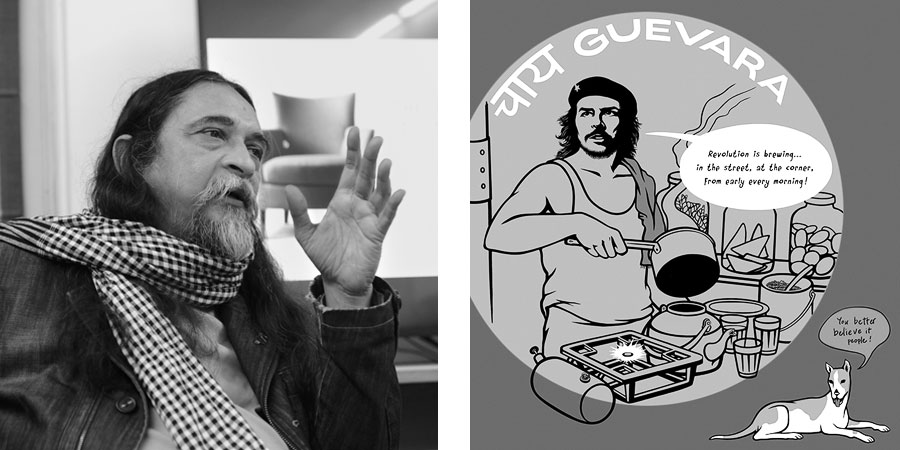
Orijit Sen is a graphic artist and a designer working with diverse mediums. His most popular works are the rhetorical and controversial political cartoons where Orijit uses satire as a tool to reflect upon his views on world politics. He uses Social Media extensively as a platform to spread his opinions across the country and mobilize thinking among the people. He reflects upon the use or rather, misuse of power by the most powerful leaders of our country.
Orijit’s idea of revolution coming from ‘down there’ is expressed by him through a series of his works which he named as Baba Marx, Chai Guevara and Bob Mali, amongst others. The idea of this series was to provoke fresh perspectives by the displacement of famous words and iconic figures that we relate to.
Each of Orijit’s works made us laugh but simultaneously, we experienced a chilling certainty when he spoke of the difficulties and danger he faces by being such a strong voice against politics and sensitive subjects. This led us to an interesting discussion on the power of Social Media, where a few of his posts have been removed from Facebook after being reported as offensive, but restored after protests from users.
The days when social media was not so popular, he found the means to express himself by forming ‘People Tree’, a collaborative shop, art space and studio, with his wife Gurpreet, back in 1990. Orijit’s work is very diverse, the most impressive being the mural at Khalsa Museum, located in Anandpur Sahib, near Chandigarh.
Written by Sarah Kaushik
Activation
Project Management
Supervision
Fabrication & Installation
© 2025 Lopez Design Pvt. Ltd. All rights reserved