
Forum No.12
7th Jan 2017
Forum No.12
7th Jan 2017
Forum No.12
7th Jan 2017
Forum No.12
7th Jan 2017
Forum No.12
7th Jan 2017
COLLABORATION | IS EPIC
COLLABORATION | IS EPIC
COLLABORATION | IS EPIC
COLLABORATION | IS EPIC
COLLABORATION | IS EPIC
VISUAL ARTIST & ARCHITECT
Vishal Kumar Dar
FOUNDER • HERITAGE COMMONS
Neeraj Bhasin
ENVIRONMENTAL ARTIST
Vibha Galhotra
VISUAL ARTIST & ARCHITECT
Vishal Kumar Dar
FOUNDER • HERITAGE COMMONS
Neeraj Bhasin
ENVIRONMENTAL ARTIST
Vibha Galhotra
VISUAL ARTIST & ARCHITECT
Vishal Kumar Dar
FOUNDER • HERITAGE COMMONS
Neeraj Bhasin
ENVIRONMENTAL ARTIST
Vibha Galhotra
VISUAL ARTIST & ARCHITECT
Vishal Kumar Dar
FOUNDER • HERITAGE COMMONS
Neeraj Bhasin
ENVIRONMENTAL ARTIST
Vibha Galhotra
VISUAL ARTIST & ARCHITECT
Vishal Kumar Dar
FOUNDER • HERITAGE COMMONS
Neeraj Bhasin
ENVIRONMENTAL ARTIST
Vibha Galhotra
SOUND ARTIST • SOUND REASONS
Ish Sherawat
GRAPHIC DESIGNER
Ishita Jain
FOUNDER • LEELA DESIGN STUDIO
Anurag Rana
SOUND ARTIST • SOUND REASONS
Ish Sherawat
GRAPHIC DESIGNER
Ishita Jain
FOUNDER • LEELA DESIGN STUDIO
Anurag Rana
SOUND ARTIST • SOUND REASONS
Ish Sherawat
GRAPHIC DESIGNER
Ishita Jain
FOUNDER • LEELA DESIGN STUDIO
Anurag Rana
SOUND ARTIST • SOUND REASONS
Ish Sherawat
GRAPHIC DESIGNER
Ishita Jain
FOUNDER • LEELA DESIGN STUDIO
Anurag Rana
SOUND ARTIST • SOUND REASONS
Ish Sherawat
GRAPHIC DESIGNER
Ishita Jain
FOUNDER • LEELA DESIGN STUDIO
Anurag Rana
VISUAL ARTIST & ARCHITECT
Vishal Kumar Dar
VISUAL ARTIST & ARCHITECT
Vishal Kumar Dar
VISUAL ARTIST & ARCHITECT
Vishal Kumar Dar
VISUAL ARTIST & ARCHITECT
Vishal Kumar Dar
VISUAL ARTIST & ARCHITECT
Vishal Kumar Dar
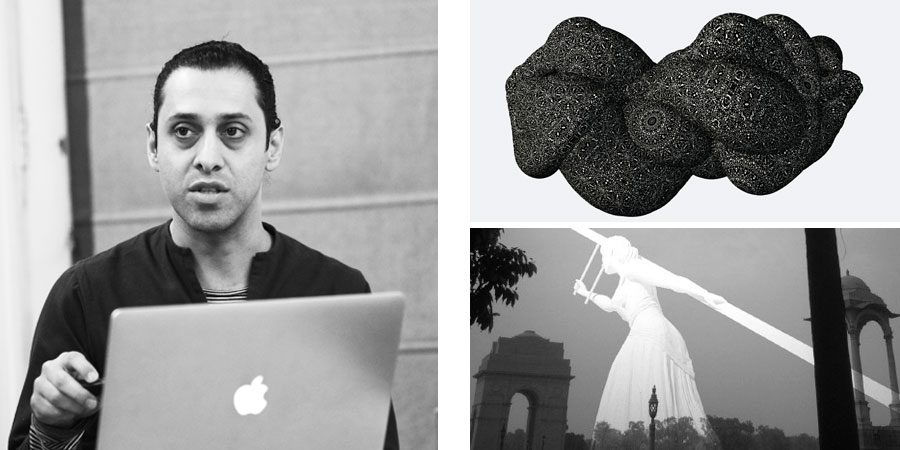
Collaboration is key to Delhi artist Vishal K Dar’s work, be it with technologists, programmers or other makers. Forty year old Dar uses satire and scale to address deeper personal issues. His practice often extends outside the gallery into abandoned sites and is diverse in terms of medium. Transformations and nocturnes are more visible themes revealing a dreamlike quality in his works.
Vishal shared his path, how after completing architecture in the late 90s, his architectural practice found its way into arts practice of mainly two groups – video and site specific works. Most of his site specific art is done by interventions in abandoned spaces or marginal spaces that sit on the edge.
Dar expresses his desire, “to see that which is invisible, an urban-parallax, achieved by injecting iconic cinematic imagery, through the illegal practice of digital architecture.” At a KHOJ residency program in 2009, Dar created a site-specific digital intervention on Google Earth, where an iconic image from Mehboob Khan’s film “Mother India” towers from behind the India Gate monument in New Delhi. His title “I am a monument”, is borrowed from Robert Venturi and Denise Scott Brown’s book, “I am a monument – On Learning from Las Vegas”.
His work “Cutter” responded to the spurious 500 rupee notes in 2009, locating an object as a landscape to challenge the notions of real or fake. Similarly his ‘Jai Jawan’ video looks at commemorative stamps produced in the 60s on Lal Bahadur Shastri’s slogan, relocating the Jawan in our current space. The state produced stamp enters the public space and Dar expands on its meaning, purpose and association.
NAAG-Z, his 2012 site-specific sculpture was brought to life through cutting-edge projection mapping technology, aspiring to deconstruct the notion of sculpture. A new version of this work titled NAAG-XY is at the Contemporary Jewish Museum in San Francisco as a part of N.E.A.T. (New Experiments in Art and Technology 2015).
Light is a recurring motif in Dar’s work and is powerfully harnessed in his ambitious 2013 site specific work ‘Prajapati’ which refers to Louis Khan’s texts on silence and light and Vedic texts. In 2015, continuing with his interest in creating experience territories and hallucinatory zones, Dar produced Maruts, his first site specific work in Pune, in an abandoned 40,000 sqft. storage facility. The Maruts are reimagined as storm deities using computer controlled oscillating beams of light set to varying metronomic meters over a vast reflection pool created with 200,000 gallons of water.
Dar tries to challenge a certain idea of authorship. When we look at his works like ‘Girl in a swing’ or the ‘Cutter’, they can be circulated endlessly on the internet and can become like any other GIF or meme. His big site specific works also work like that. You have these mesmerising light experiences connecting with the site can offer to you rather than walking into a space which is authored in a specific way or style imposed with an artistic stamp.
Written by Deekshit Sebastian
Collaboration is key to Delhi artist Vishal K Dar’s work, be it with technologists, programmers or other makers. Forty year old Dar uses satire and scale to address deeper personal issues. His practice often extends outside the gallery into abandoned sites and is diverse in terms of medium. Transformations and nocturnes are more visible themes revealing a dreamlike quality in his works.
Vishal shared his path, how after completing architecture in the late 90s, his architectural practice found its way into arts practice of mainly two groups – video and site specific works. Most of his site specific art is done by interventions in abandoned spaces or marginal spaces that sit on the edge.
Dar expresses his desire, “to see that which is invisible, an urban-parallax, achieved by injecting iconic cinematic imagery, through the illegal practice of digital architecture.” At a KHOJ residency program in 2009, Dar created a site-specific digital intervention on Google Earth, where an iconic image from Mehboob Khan’s film “Mother India” towers from behind the India Gate monument in New Delhi. His title “I am a monument”, is borrowed from Robert Venturi and Denise Scott Brown’s book, “I am a monument – On Learning from Las Vegas”.
His work “Cutter” responded to the spurious 500 rupee notes in 2009, locating an object as a landscape to challenge the notions of real or fake. Similarly his ‘Jai Jawan’ video looks at commemorative stamps produced in the 60s on Lal Bahadur Shastri’s slogan, relocating the Jawan in our current space. The state produced stamp enters the public space and Dar expands on its meaning, purpose and association.
NAAG-Z, his 2012 site-specific sculpture was brought to life through cutting-edge projection mapping technology, aspiring to deconstruct the notion of sculpture. A new version of this work titled NAAG-XY is at the Contemporary Jewish Museum in San Francisco as a part of N.E.A.T. (New Experiments in Art and Technology 2015).
Light is a recurring motif in Dar’s work and is powerfully harnessed in his ambitious 2013 site specific work ‘Prajapati’ which refers to Louis Khan’s texts on silence and light and Vedic texts. In 2015, continuing with his interest in creating experience territories and hallucinatory zones, Dar produced Maruts, his first site specific work in Pune, in an abandoned 40,000 sqft. storage facility. The Maruts are reimagined as storm deities using computer controlled oscillating beams of light set to varying metronomic meters over a vast reflection pool created with 200,000 gallons of water.
Dar tries to challenge a certain idea of authorship. When we look at his works like ‘Girl in a swing’ or the ‘Cutter’, they can be circulated endlessly on the internet and can become like any other GIF or meme. His big site specific works also work like that. You have these mesmerising light experiences connecting with the site can offer to you rather than walking into a space which is authored in a specific way or style imposed with an artistic stamp.
Written by Deekshit Sebastian
FOUNDER • HERITAGE COMMONS
Neeraj Bhasin
FOUNDER • HERITAGE COMMONS
Neeraj Bhasin
FOUNDER • HERITAGE COMMONS
Neeraj Bhasin
FOUNDER • HERITAGE COMMONS
Neeraj Bhasin
FOUNDER • HERITAGE COMMONS
Neeraj Bhasin
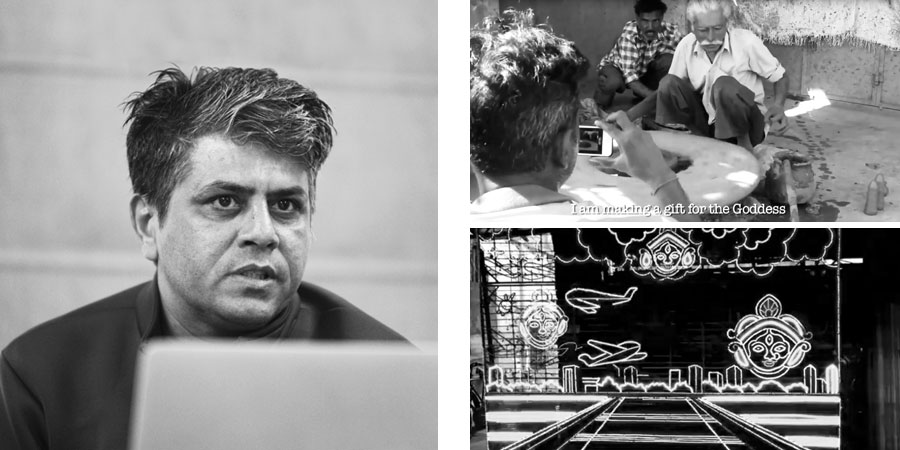
Arts practitioner and filmmaker, Neeraj Bhasin’s collaboration with the art industry is particularly interesting. Heritage Commons, a not for profit organisation and Ihsan Talkies Production, both founded by Neeraj, aim to work in the space of art documentation and museology. At the Forum, Neeraj presented his recent engagement with the art fraternity as a filmmaker.
Heritage Commons creates digital knowledge bases for art institutions like museums and galleries. Existing museums and galleries in our country are extremely insular and wrongly perceived as intellectual institutions for the elite. Heritage Commons pushes the envelope to create state of the art experiences for facilities to be at par with leading museums and galleries of the world, especially with regards to technology. Digital documentation helps creating virtual data to share with the layman using interactive interfaces, which help institutions to reach out to a larger spectrum of people. These methods aim to eventually gather higher footfall.
Neeraj shared two of his latest projects that adopt vastly different approaches to documenting an art program. For the GVK Mumbai T2 Museum, films created were shot on iPhones. Using hardware that was handy but not overly imposing, the team was able to capture candid moments with artists, and also craftsmen in remote areas in the country. The films can be now seen in the digital signage for the museum at the airport and their dedicated website.
Although the aesthetic was very different from the iPhone film, the second project, a film for Kiran Nadar Museum of Art, was very well made. Neeraj referred to this commercial approach as ‘glossy’. With a specific brief for a pre-defined audience, the purpose was to document a large show on “Constructs”. The film captured the essence of the show and had footage intercut of artists explaining their exhibited works.
Neeraj is now looking forward to collaborate with fellow design & art practitioners to create custom made proposals for the country’s museum and galleries. Along with Creative Commons, he hopes to continue to create alternative experiences for these art institutions to dissipate the information to reach the “commons” using readily accessible technology.
Written by Surajit Ranjan Das
Arts practitioner and filmmaker, Neeraj Bhasin’s collaboration with the art industry is particularly interesting. Heritage Commons, a not for profit organisation and Ihsan Talkies Production, both founded by Neeraj, aim to work in the space of art documentation and museology. At the Forum, Neeraj presented his recent engagement with the art fraternity as a filmmaker.
Heritage Commons creates digital knowledge bases for art institutions like museums and galleries. Existing museums and galleries in our country are extremely insular and wrongly perceived as intellectual institutions for the elite. Heritage Commons pushes the envelope to create state of the art experiences for facilities to be at par with leading museums and galleries of the world, especially with regards to technology. Digital documentation helps creating virtual data to share with the layman using interactive interfaces, which help institutions to reach out to a larger spectrum of people. These methods aim to eventually gather higher footfall.
Neeraj shared two of his latest projects that adopt vastly different approaches to documenting an art program. For the GVK Mumbai T2 Museum, films created were shot on iPhones. Using hardware that was handy but not overly imposing, the team was able to capture candid moments with artists, and also craftsmen in remote areas in the country. The films can be now seen in the digital signage for the museum at the airport and their dedicated website.
Although the aesthetic was very different from the iPhone film, the second project, a film for Kiran Nadar Museum of Art, was very well made. Neeraj referred to this commercial approach as ‘glossy’. With a specific brief for a pre-defined audience, the purpose was to document a large show on “Constructs”. The film captured the essence of the show and had footage intercut of artists explaining their exhibited works.
Neeraj is now looking forward to collaborate with fellow design & art practitioners to create custom made proposals for the country’s museum and galleries. Along with Creative Commons, he hopes to continue to create alternative experiences for these art institutions to dissipate the information to reach the “commons” using readily accessible technology.
Written by Surajit Ranjan Das
ENVIRONMENTAL ARTIST
Vibha Galhotra
ENVIRONMENTAL ARTIST
Vibha Galhotra
ENVIRONMENTAL ARTIST
Vibha Galhotra
ENVIRONMENTAL ARTIST
Vibha Galhotra
ENVIRONMENTAL ARTIST
Vibha Galhotra
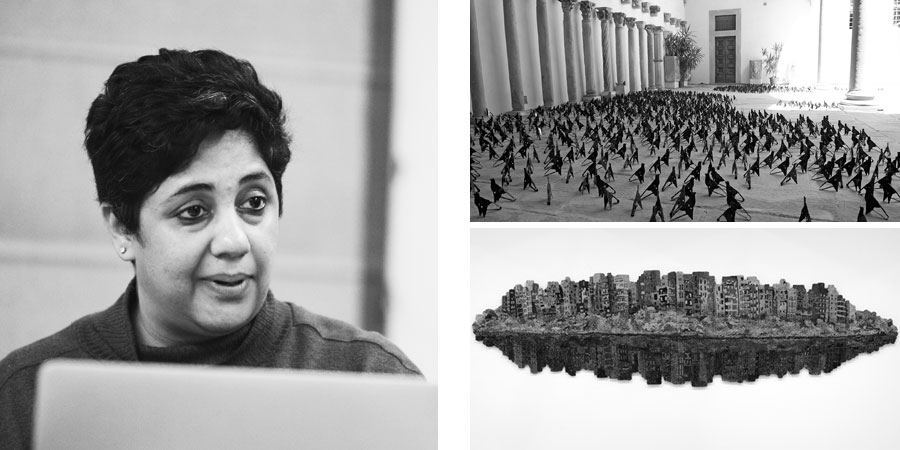
Vibha Galhotra describes herself as an environmental artist, an uncommon term amongst artists in India. Her works largely focus on urban development in India and its consequences on the surrounding environment.
The huge play of scale throughout Vibha’s works is fascinating. Sometimes, she uses repetition of small delicate forms of birds to form a landscape, and then to the massive inflated golden form of a bulldozer charging through the streets of the city. Her work is meant to interact with the common people, to make them aware of the current state of the environment as well as the dangers posed by urban development. Vibha makes a lot of site-specific artworks in locations she stumbles upon, which are captured in the form of impactful photographs or films.
Besides sculptures, Vibha showed us her framed paintings which had intriguing splashes of what appeared to be a thick black substance, giving the effect of a Jackson Pollock painting. We were informed later that the splashes were muck collected from river Yamuna preserved as it were by vinyl.
Another interesting part of her practice is her engagement with women in her art, offering them employment opportunities. She trains women at her studio to work with Ghungroos, metallic bells, which are extensively used in her artworks to create landscapes. The metal bells are very intricate and only become evident when the viewer is very close to the artwork. Hence, there is a lot of macro and micro viewing in her artworks.
On being asked whether she feels her work is contributing to making a change to the current situation of the environment, she stated that she wouldn’t call herself an activist. However, her art gives her the liberty to communicate the subject matter with emotional and philosophical layering. Through her art, she has found a way to express her concerns and hopes to generate awareness amongst the common man.
We were all mesmerized by the satirical and poetic content of Vibha’s works and her pun-intended entertaining presentation.
Written by Sarah Kaushik
SOUND ARTIST • SOUND REASONS
Ish Sherawat
SOUND ARTIST • SOUND REASONS
Ish Sherawat
SOUND ARTIST • SOUND REASONS
Ish Sherawat
SOUND ARTIST • SOUND REASONS
Ish Sherawat
SOUND ARTIST • SOUND REASONS
Ish Sherawat
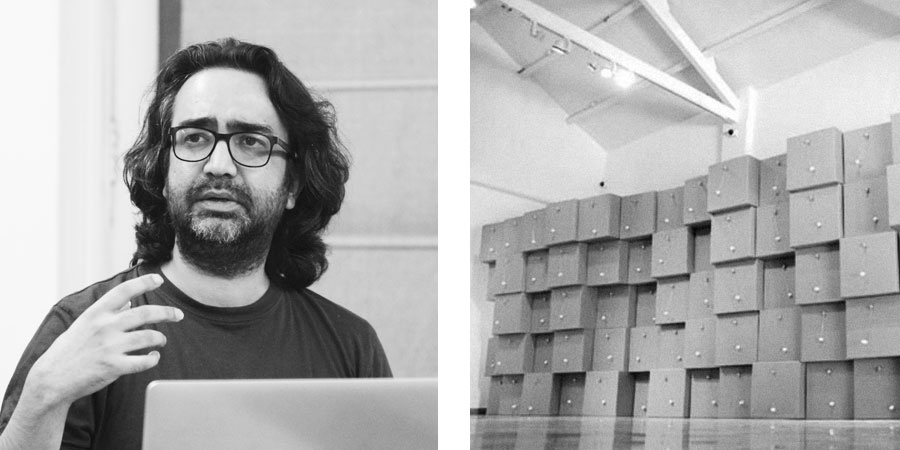
Sound Artist, Ish Sherawat discovered his liking for electronic music right when the music scene began changing dramatically in the late 1990s. It was a discovery for him as he believes that music was changing the same way he was changing, thereby making him see and feel a connect with music as a transformational medium. He started making music tapes in college and after graduating, he moved on to producing music on his computer with the help of dedicated production software.
Having learnt to play a guitar, Ish found it very liberating to know that there existed a platform – electronic music, that let him step out of the traditional way of making music. However, he believes that the current electronic music scene is more of an act than an actual performance. His interest lies in recording sounds from everyday life and manipulating and re-arranging them to soulful sound. There is definitely a sense of satisfaction to arrange off-beat sounds to make great compositions. Ish strongly believes that a produced sound has its own time and space just like a movie, except, a sound track does not have the similar visual representation to be able to interpret it. Ish also abolished the concept of listening to music from two speakers during his presentation. Using two speakers for right and left he believes is a misconception as such a wide medium of sound cannot be simply reduced to two channels. He believes in mastering the art of accoustics to get the most out of speakers.
Ish says that he lost interest in playing in bands right from his college days. His interest in bands started waning when he found that he was playing for an audience that cheered their on-stage presence more than their talent; added to this was the lack of experimentation in how they approached music. He occasionally plays in bands even now, but prefers very open-minded groups that like to make music on the spot by improvising with objects around them.
Ish Sherawat’s project, ‘diFfuSed beats’ is a great example for his eclectic understanding of this much loved art form. He also produced music using sounds in nature which was played at ‘Sound Reasons’, an electronic music festival held at ‘Shoonya – Centre for Arts and Somatic Practises’, organised by ‘Pro Helvetia – The Swiss Arts Council in India’.
Written by Agnisesh Setlur
GRAPHIC DESIGNER
Ishita Jain
GRAPHIC DESIGNER
Ishita Jain
GRAPHIC DESIGNER
Ishita Jain
GRAPHIC DESIGNER
Ishita Jain
GRAPHIC DESIGNER
Ishita Jain
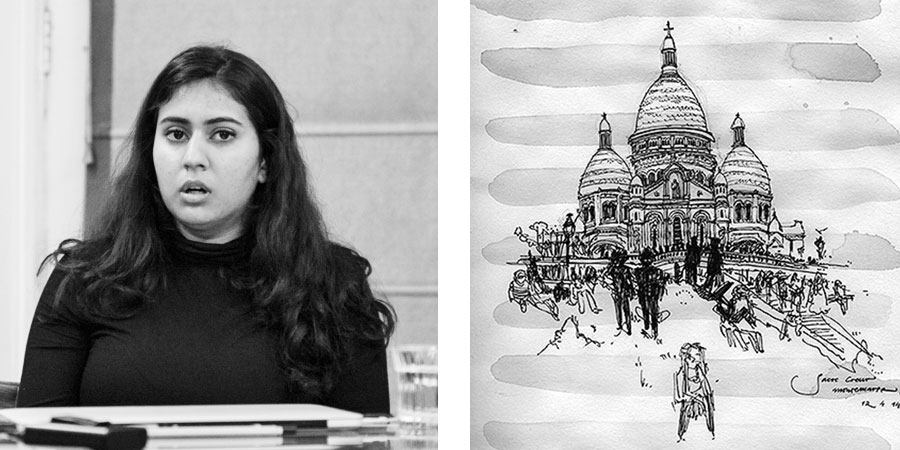
Young, bright and enthusiastic Ishita describes herself as a visually driven person. She thinks and sees better when she draws and never leaves home without a sketchbook. A recent graduate of graphic design from NID, Ishita was the fifth presenter of the forum and her presentation was rather different from the others.
She shared her journey as a designer through her sketch books. She likes to sketch & paint wherever she goes – a habit she nurtured, which became more of a ritual during her exchange program in France. To viewers, her sketchbooks are a reflection of her experiences and a real visual treat. Ishita’s skills in water colors and calligraphy is simply amazing. It was interesting to see how she collected little souvenirs from many places she travelled to, from maps to museum tickets and so on. The collection of her sketchbooks from the past few years also displayed how she has gradually improved her skills.
In today’s time when most designers are using varied software, this upcoming designer is rare in honing her hand skills instead. Currently, her concentration has been to understand what graphic design means to her and how to infuse design thinking and visualization skills into varied platforms that would eventually become central to her interest.
Written by Ankita Singh
FOUNDER • LEELA DESIGN STUDIO
Anurag Rana
FOUNDER • LEELA DESIGN STUDIO
Anurag Rana
FOUNDER • LEELA DESIGN STUDIO
Anurag Rana
FOUNDER • LEELA DESIGN STUDIO
Anurag Rana
FOUNDER • LEELA DESIGN STUDIO
Anurag Rana
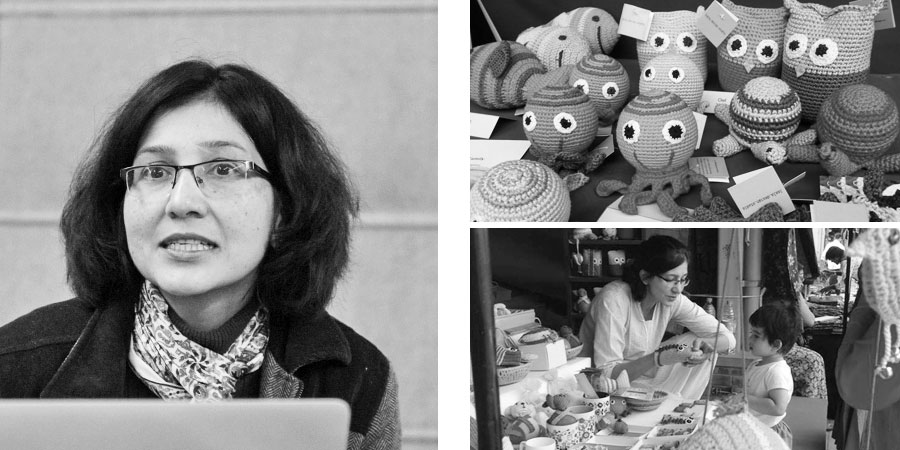
The last presenter of the January Lopez Design forum spread out the latest products she had worked on across the table. All present in the forum were immediately engrossed in scrutinizing each product and kept passing them around the room. Once everyone had gone through the products and settled down Anurag Rana began her story.
Anurag, a Textile designer from NID, began her journey with the House of Kotwara as an intern. She worked in the Kotwara design studio where she was introduced to the term “dwar-pe-rozi”, which translates to “take the work to the people in the space they belong to”. Dwar-pe-rozi is the name of the non-profit programme where embroidery work was commissioned to women in near by villages. Anurag felt that dwar-pe-rozi allows design to evolve in it’s natural environment. This was the main take away for her from this internship and it went on to form an important part of her life.
During her final year in NID, Anuraj went to Assam in the hope of finding a graduation project in a bamboo workshop. Once she reached there she travelled around Assam, lived with different tribes, learnt about their life and interacted with the artisans present there. When she came back to college she was charged up to make a difference. Anurag called her point of contact, Sanjoy Ghose (an Indian rural development activist known for his pioneering contributions to community health and development media) only to be informed that he has been kidnapped and the entire workshop had been cancelled. Anurag realised the weight of doing a social intervention through design. Anyone could have been killed, even her.
Anurag’s first job after graduation was at Fabindia. William Bissell’s, owner of Fabindia, faith in her instilled a passion for fibres. As part of the design studio she worked and hand held ‘kaarigars’ to ensure they received design direction, had regular work and took design to the next level. There was a very fine line between where Anurag’s design and where the weavers intervention began and ended. As time went by she realised that design was an over hyped word in the world of craft. Livelihood was such an essential element that very few design students were willing to experiment with new designs. Her journey with Fabindia ended as she realised that she wanted to work with artisans and take design to a different level.
The next step in Anurag’s life was Leela design studio, which revolved around working with local artisans. Anurag experimented with vegetables dyes, knitting, crochet, weaving, different fabrics and materials. She found buyers in the UK and also exported products to Fabindia. Anurag describes this experience as the best time of her life. The studio was set up with the least amount of infrastructure. Rural technology like a Indian version of the Bradford wheel, solar heater to heat water for dyeing and other domestic purposes were used. And her best designs happened during that period.
With over 20 years of experience, Anurag strongly felt that the possibility of projects that will positively impact society are endless and the needs of these people are real. However the funds that these crafts persons receive are limited and this prompted her to establish Mon Ami Foundation. Her recent project whose output she shared in the beginning of the presentation involves training, skill development, production and design, outreach through bazaar and events for women in the rural urban pockets around Delhi – NCR region to develop vegetable dyed crochet toys for children. The aim being sustainability, which is our future.
Written by Shivani Prakash
Activation
Project Management
Supervision
Fabrication & Installation
© 2025 Lopez Design Pvt. Ltd. All rights reserved