
Forum No.22
10th Mar 2018
Forum No.22
10th Mar 2018
Forum No.22
10th Mar 2018
Forum No.22
10th Mar 2018
Forum No.22
10th Mar 2018
COLLABORATION | SIGNALS CHANGE
COLLABORATION | SIGNALS CHANGE
COLLABORATION | SIGNALS CHANGE
COLLABORATION | SIGNALS CHANGE
DIRECTOR • THE ACHI ASSOCIATION
Abeer Gupta
CO-FOUNDER • STUDIO HASH
Akash
DOCUMENTARY FILMMAKER
Anurag Singh
DESIGNER
Mani Shama
DIRECTOR • THE ACHI ASSOCIATION
Abeer Gupta
CO-FOUNDER • STUDIO HASH
Akash
DOCUMENTARY FILMMAKER
Anurag Singh
DESIGNER
Mani Shama
DIRECTOR • THE ACHI ASSOCIATION
Abeer Gupta
CO-FOUNDER • STUDIO HASH
Akash
DOCUMENTARY FILMMAKER
Anurag Singh
DESIGNER
Mani Shama
DIRECTOR • THE ACHI ASSOCIATION
Abeer Gupta
CO-FOUNDER • STUDIO HASH
Akash
DOCUMENTARY FILMMAKER
Anurag Singh
DESIGNER
Mani Shama
DIRECTOR • THE ACHI ASSOCIATION
Abeer Gupta
CO-FOUNDER • STUDIO HASH
Akash
DOCUMENTARY FILMMAKER
Anurag Singh
DESIGNER
Mani Shama
ARTIST
Prerna Shekhar
PARTNER • ORPROJECT
Rajat Sodhi
ARCHITECT
Viraj Kataria
ARTIST
Prerna Shekhar
PARTNER • ORPROJECT
Rajat Sodhi
ARCHITECT
Viraj Kataria
ARTIST
Prerna Shekhar
PARTNER • ORPROJECT
Rajat Sodhi
ARCHITECT
Viraj Kataria
ARTIST
Prerna Shekhar
PARTNER • ORPROJECT
Rajat Sodhi
ARCHITECT
Viraj Kataria
ARTIST
Prerna Shekhar
PARTNER • ORPROJECT
Rajat Sodhi
ARCHITECT
Viraj Kataria
DIRECTOR • THE ACHI ASSOCIATION
Abeer Gupta
DIRECTOR • THE ACHI ASSOCIATION
Abeer Gupta
DIRECTOR • THE ACHI ASSOCIATION
Abeer Gupta
DIRECTOR • THE ACHI ASSOCIATION
Abeer Gupta
DIRECTOR • THE ACHI ASSOCIATION
Abeer Gupta
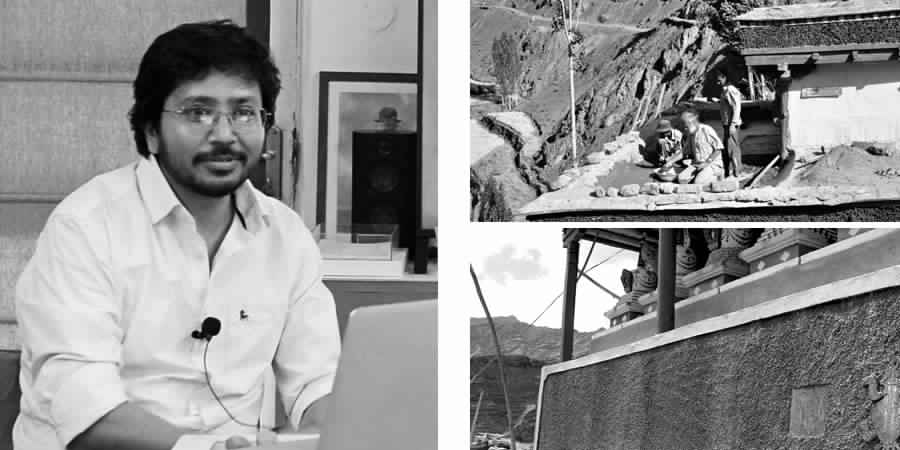
Trained as a filmmaker and visual anthropologist, Abeer Gupta has been interested in documentary work. In his profession, he gets the opportunity to visit parts of the world one rarely encounters. One such experience took him to Ladakh in 2006 – this is a place with the capacity to hook people on and never let them go, according to Abeer. He encountered a small community in the region, which kept him plugged in and he has completed fifteen years of work.
Abeer likes to think of himself primarily as a filmmaker. Filmmaking plays an important role in his life: it introduced him to the idea of construction and representation, which run as a thematic across his work and writings. He currently teaches at the Ambedkar University, Delhi and runs a number of small projects in Ladakh and Kashmir.
Abeer is a director at The Achi Association, which is an organisation created in the 1990s. The people involved with the association are painters, restorers, architects and painting conversation people. The Achi Association primarily works with conservation and restoration of mud buildings. Their team’s expertise lies in earthen architecture, which can be found in the regions between Leh and Kargil. They have worked on multiple sites in the 80s and 90s. This Association is a platform for experts to help consolidate their efforts in the region. The association likes to encourage community collaboration through their work and thereby opens a platform for dialogue. Since the year 2013-14 Abeer has been a director.
Abeer also took us through a short portion of his visual anthropological research (2010 – 2011) in Ladakh. When he started travelling to Ladakh, he noticed a Muslim culture of significant historic value. He notes that historically, Ladakh has always been at the center of an extremely important trade circuit. If one looks at its material culture, it is very rich as everything has arrived from different parts of the world and it constitutes as being in some ways an integral Ladakhi culture. Today, this becomes important as we are constantly trying to define our culture very precisely by shutting out parts. This is the opposite of how culture is defined, something very porous and interactive.
At the middle of the 20th century, Leh was connected to the western world through Lahore and Kashmir. Abeer showed us images of carpets from Jama Masjid in Leh pointing out elements borrowed from Yarken, Turkey, Kashmir, Tibet and central Asia. The elements are not derived from religious aesthetic parameters. These objects had filtered in during trade and they had been setting the aesthetic standards of space in the minds of the people. Abeer moved on to show an image of Alams (flags or signs important to Shia) created by the local women – they had visualised Islam in Shia iconography, even without any prior exposure.
Abeer’s presentation opened up windows to how people were constructing their worlds within Ladakh. He took us through multiple such examples, where we saw symbols, patterns and objects relating to varied cultures and religions, coming together due to the movement of people. His research will be released in March 2018.
Written by Shivani Prakash
CO-FOUNDER • STUDIO HASH
Akash
CO-FOUNDER • STUDIO HASH
Akash
CO-FOUNDER • STUDIO HASH
Akash
CO-FOUNDER • STUDIO HASH
Akash
CO-FOUNDER • STUDIO HASH
Akash
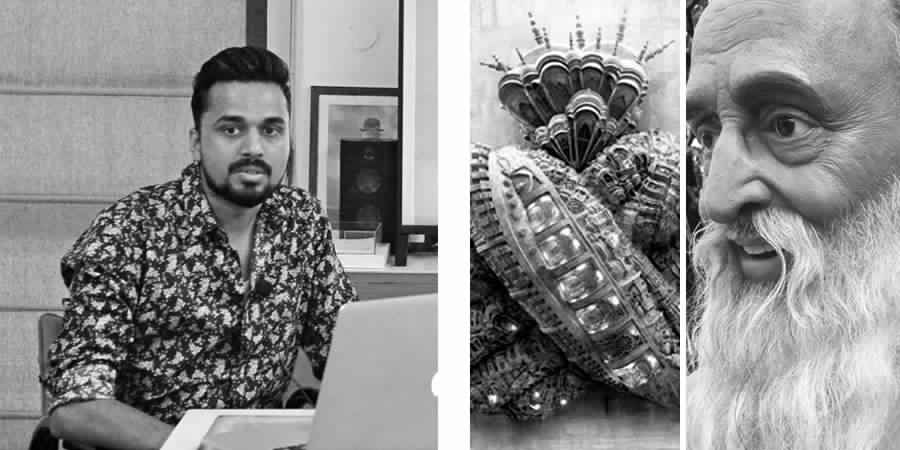
Studio Hash is a partnership firm that is run by two sculptors and two painters – Rakesh, Harpreet, Gurpreet and Akash. Studio Hash specialises in making props for movies, museums and public spaces. They deserve all the credit for creating an almost human silicon sculpture of Swami Chinmayananda at the Swami Chinmayananda Museum. The artists make use of moulds made out of fibre glass to produce these sculptures. The process is time consuming. The moulds are first made in clay, then wax and then fibre glass. Depending on the budget for each sculpture (depends on the fame of the personality) each strand of hair gets grafted. Natural hair is used for the more expensive sculptures.
The group has also made a sculpture of the Chief Minister of Himachal. For an extremely important person such as the Chief Minister, details are crucial. The personality’s face was photographed and features were sculpted by hand to get as much as detail possible. Unlike photographs, 3D mapping does not help in achieving the same quality in the result. The human body parts that are exposed, such as the face and the hands, are of silicon and the rest of the body is made from fibre glass. Approximate costs for a sculpture of this kind is 3.54 Lakhs. Apart from the sculptures, Studio Hash makes body suits for actors in movies and prosthetic make up. They also make fake dogs, cats and snakes. The group has visualised and produced several extremely intricate sculptures, of which one is at the T2 airport in Mumbai.
Written by Agnisesh Setlur
DOCUMENTARY FILMMAKER
Anurag Singh
DOCUMENTARY FILMMAKER
Anurag Singh
DOCUMENTARY FILMMAKER
Anurag Singh
DOCUMENTARY FILMMAKER
Anurag Singh
DOCUMENTARY FILMMAKER
Anurag Singh
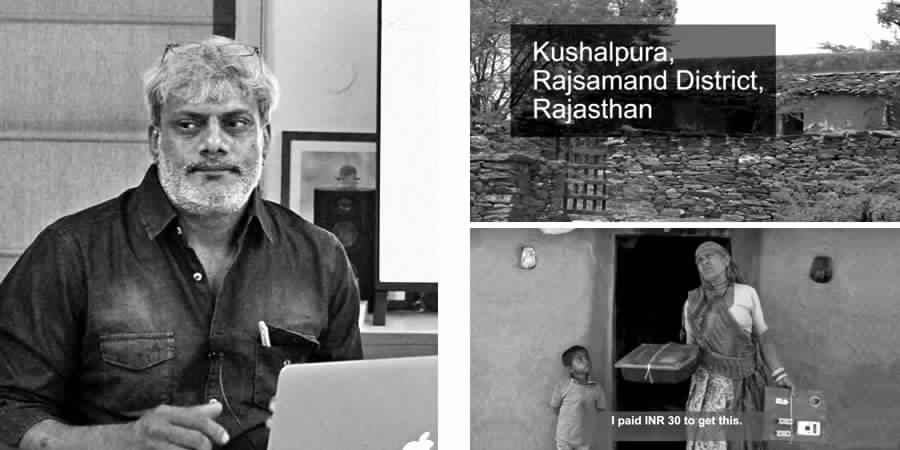
A documentary filmmaker, Anurag Singh has been practicing the art for a couple of years now. He along with his team (Rough Cut Productions), work as social designers by documenting various movements. They also look out for anyone who needs a voice and those who may have fallen out of favour with the government, leaving them in a position of disadvantage.
One of Anurag’s documentaries, Morning Prayers, shows the daily routine every morning in a school in Ajmer district. While a quote in the school says that ‘boys and girls are both equal, both are nature’s blessings’, ironically the school instructs girls to clean up and sweep ‘as girls need the training’. This documentary was not a preplanned one – they had visited the locality for another purpose, but these school kids caught the team’s attention.
Many villagers of Kushalpura in Rajasthan have lost lives because of one of India’s most overrated social design movement, the Aadhaar card. More than 2.95 lakh pensioners have been marked dead and their names removed from the pension and ration list, claiming these are fake. Villagers have no access to food grains, nor does their health allow them to run behind government officials to apply for a card.
The film Electricity is coming talks about privatisation of companies and lack of supply of basic resources. The promises made by the government are not fulfilled, leaving the villagers waiting for years after been given meter boxes, for something as basic as electricity. These villagers are technologically challenged and left wondering about the mystery of the meter box and electricity.
These are all examples of documentaries made for a social cause, strong stories about the lack of basic shelter, food, jobs and electricity. The villagers meanwhile put in extraordinary effort to keep up with the high technology in advanced parts of society. Anurag and his team have been working on spreading this voice, looking for ears that will respond to their call. They hope that all the hard work and efforts of these villagers gets the attention of the right people. Rough Cut Productions’ films are available for free viewing on Youtube and other social media.
Written by Shipra Balasubramani
DESIGNER
Mani Sharma
DESIGNER
Mani Sharma
DESIGNER
Mani Sharma
DESIGNER
Mani Sharma
DESIGNER
Mani Sharma
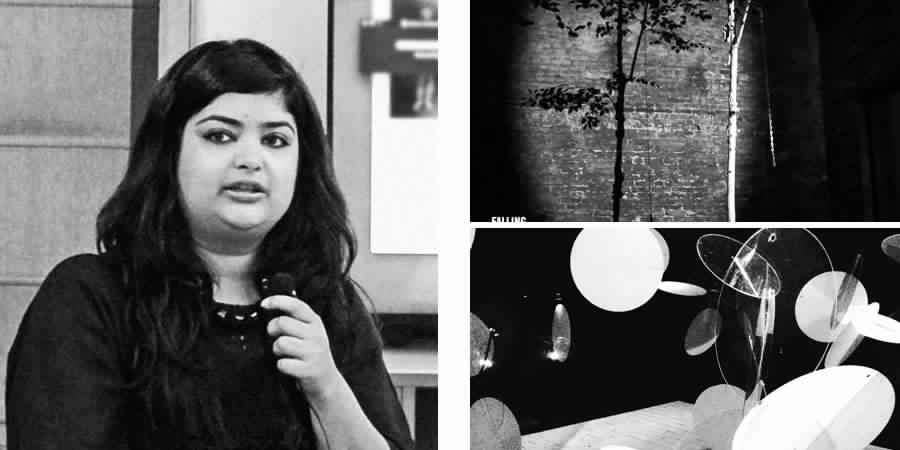
Mani Sharma is a Delhi-based designer working in mixed media. She did her graduation from Shri Ram College of Commerce and went to Srishti, Bangalore to study design foundation. Mani also did a course in Interior and Architecture from the Pearl Academy. After exploring a couple of fields, she realised that her true interest lies in animation. Working in media that were essentially static did not really excite her much – Mani followed her instincts and went to BTK, Berlin, where she did her Masters in Design media spaces. Being a person with multiple interests, she did a variety of exhibition, retail window display, interior and furniture design projects as a freelance artist. In 2009, she dabbled in the field of textile and later interned in an architecture office.
Mani spoke about how does one perceives the self-image image and how social media reacts to it. She worked on an installation which was a play on notions of privacy and manipulation of one’s image. It was her initiative to document the process of how people are becoming an abstract digital identity and how this has influenced their self image, which is very evident through social media. While Mani has also worked on other collaborative projects, a huge chunk of her work is in the form of interactive installations that involve sound and motion. This young and passionate designer is always on her toes to explore and dabble with new things.
Written by Jigyasa Thukral
Mani Sharma is a Delhi-based designer working in mixed media. She did her graduation from Shri Ram College of Commerce and went to Srishti, Bangalore to study design foundation. Mani also did a course in Interior and Architecture from the Pearl Academy. After exploring a couple of fields, she realised that her true interest lies in animation. Working in media that were essentially static did not really excite her much – Mani followed her instincts and went to BTK, Berlin, where she did her Masters in Design media spaces. Being a person with multiple interests, she did a variety of exhibition, retail window display, interior and furniture design projects as a freelance artist. In 2009, she dabbled in the field of textile and later interned in an architecture office.
Mani spoke about how does one perceives the self-image image and how social media reacts to it. She worked on an installation which was a play on notions of privacy and manipulation of one’s image. It was her initiative to document the process of how people are becoming an abstract digital identity and how this has influenced their self image, which is very evident through social media. While Mani has also worked on other collaborative projects, a huge chunk of her work is in the form of interactive installations that involve sound and motion. This young and passionate designer is always on her toes to explore and dabble with new things.
Written by Jigyasa Thukral
ARCHITECT
Viraj Kataria
ARCHITECT
Viraj Kataria
ARCHITECT
Viraj Kataria
ARCHITECT
Viraj Kataria
ARCHITECT
Viraj Kataria
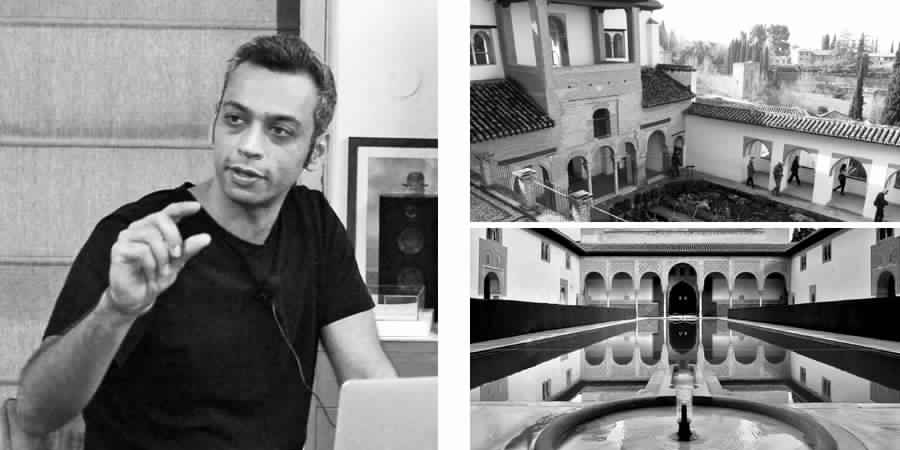
Viraj Kataria is an architect at Achal Kataria Architects who specialise in hospitality, educational buildings and master planning. Viraj has an interest in reinventing our outlook towards spaces, for instance planning a hospital like a place of wellbeing rather than as a typical hospital. In his presentation, he showed projects that have special focus on integrating buildings with the ecosystem.
Viraj began by expressing his love for the Alhambra at Granada in Spain to explain how people interact with spaces and how water manifests itself in a space. Describing water travelling across spaces, he spoke about designing the movement of water under gravity through different methods such as fountains and channels. Water is closely tied to ‘Flow’ – the endless movement, with pauses but no dead ends. The idea of flow exists in work, conversation and the elements. If the client and you are in tandem, it allows a flow.
Viraj explained what he tries to do in most of his projects, is reduce and increase the scale of the spaces to allow for walking, pausing and contemplating transitional spaces. He often picks a particular landmark as the end goal of the journey as a prize, such as a large banyan tree on a property. This is the same philosophy used for an ongoing project in Dharamsala. The aim was to create a landscape for a resort which is not overpowering and celebrates the local ecology by creating installations with local materials. Viraj spoke about the process of rejuvenating the landscape before building which include multiple interventions. A JCB (generic term for mechanical digger or excavator) was not used to dig the land as it destroys the soil – land must be cut at 45 degrees he explained, and not a mechanical 90 degrees. Recharge pits for water conservation were dug and parasitic plants were removed from the entire property. Over time water channels, ponds and bandhs were constructed systematically and the surrounding forest begun regenerating.
The resort structure is built around this naturally rejuvenated land with courtyards between hotel blocks, paths leading into the forests and a watchtower to observe all the surrounding green. For Viraj the whole journey has been to enhance experiences through space.
Written by Madhavi Menon
PARTNER • ORPROJECT
Rajat Sodhi
PARTNER • ORPROJECT
Rajat Sodhi
PARTNER • ORPROJECT
Rajat Sodhi
PARTNER • ORPROJECT
Rajat Sodhi
PARTNER • ORPROJECT
Rajat Sodhi
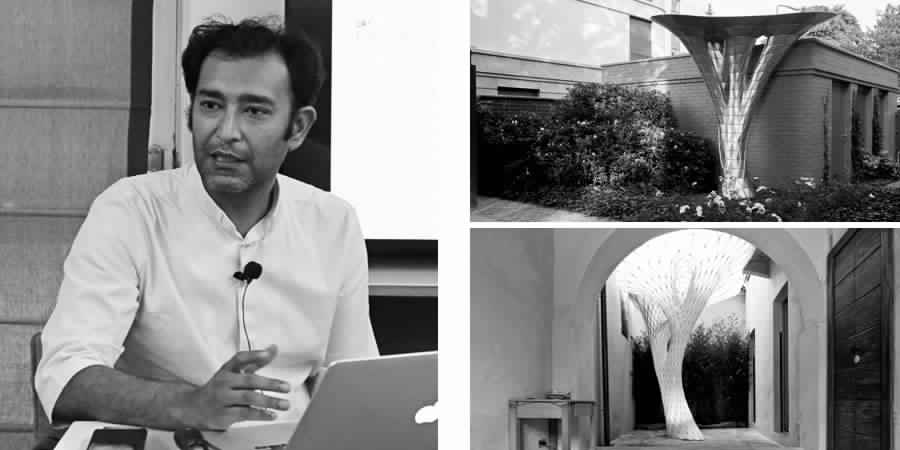
Architect Rajat Sodhi worked for ten years in Europe and the UK before returning to India where he is now a partner at Orproject, managing the New Delhi Office. Orproject is a research based architecture and design practice set up in 2006, with offices in London, Beijing and New Delhi. They work on small-scale installations to large real estate development projects, from the planning stage to execution.
Rajat did his diploma from the AA (Architectural Association School of Architecture) in London in 2007 following up with their DRL program (a 16-month post-professional design program) getting his masters in 2009. Rajat has worked with Herzog & de Meuron, Foster + Partners, Morphogenesis Architecture Studio and Le Groupe Arcop as well as with Zaha Hadid and Jean Nouvel (the Louvre project). He has given lectures and taken workshops at Architectural Association, University of Westminster and the Indian Institute of Technology in New Delhi.
Most of the projects he presented draw inspiration from nature by exploring material formations inspired by nature’s inherent optimizations. Being interested in coding and programming, Rajat ventures into computational geometry to create algorithms to invent new structures and patterns. While design is often branded as an intuitive field, the process he follows is counter-intuitive. He generally explores structures in an axiomatic way where the function of the structure is unknown. It is later implemented as a real life solution for a real life problem after studying and analyzing its potential and possibilities. ‘Gaizoushoku’ was one such project where he created forms and structures to see how cancer cells grow. The form turned out to be perfect to create a chandelier for a cafe project they were working on. Function followed form in this case.
Rajat has worked on extensive projects like OR1 and OR2 where the roof structure is biomimetic, that is, nature as a source of inspiration. A self- supporting, photochromic canopy was designed where pigments react to the sun’s UV light and change color. This highly mathematical and precise structure required special software components to create the shapes. ARBOR, ANISTROPIA, BUBBLES, ECHO, SAHYA – are other select projects he has worked on.
Written by Riya Mahajan
ARTIST
Prerna Shekhar
ARTIST
Prerna Shekhar
ARTIST
Prerna Shekhar
ARTIST
Prerna Shekhar
ARTIST
Prerna Shekhar
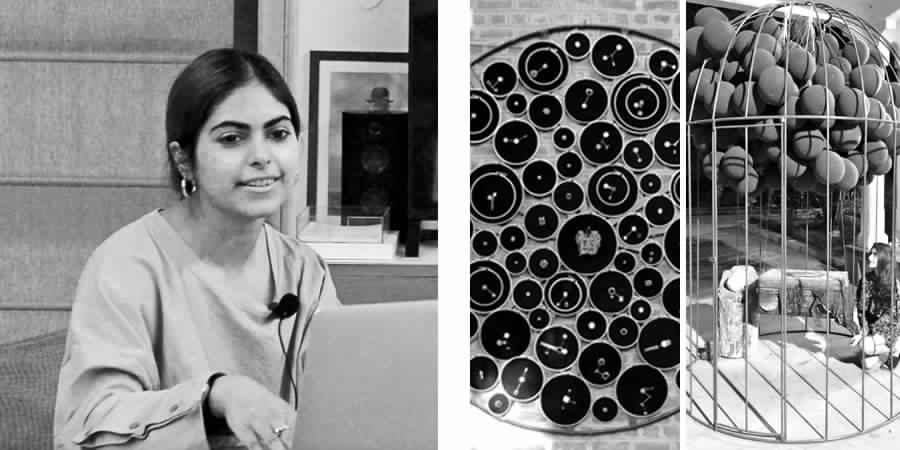
Sculptor and installation artist Prerna Shekhar graduated from the Baroda School of Arts. Choosing to do sculpture, Prerna was confronted with conventional materials such as red clay, stone, wood and metal. Unable to make a personal connection with these traditional media, Prerna gravitated towards found materials, realizing she needed to establish ‘a sense of belonging’. When we think of character, we think of people, but every material has immense character, from pressed flowers to aged wood, explains Prerna.
Her need for making an emotional connect with objects goes back to her childhood, growing up in Ranchi, a small town. As she had few opportunities to have meaningful social interactions, she frankly admits she thought people were a waste of time. This led her to become preoccupied with things more than people. Prerna makes large installations, which people can enter and explore, such as in her piece Introversion. In a life size cage, she assembled objects which have varied meanings for her: a cluster of gray balloons represents a cloud of emotions. Then, there is a dress her mother stitched for her recalling childhood, while the stone balloon is Prerna herself surrounded by emotions and memories. She defines the contrast between the times by using red shiny material for today and aged wood for the past. Within this 9 ft. x 6 ft. work, people could come and write a word about their childhood like ‘chocolate’. This interactive element in the piece, which was displayed in Baroda and then Mumbai, led to interesting conversations.
Prerna’s works tend to revisit things which have a sense of belonging, presence and memory. In ‘When breath becomes air’, Prerna used dismantled watch dials she had collected from scrap markets and from people. She put together a total of 140 dials and 110 embroidery hoops in a circular form, which some people see as a sundial. Prerna who is open to these interpretations, explains her objective. “You know how you keep wearing your watch and looking at the time, but you keep changing your watch? It’s not constant throughout your life time”, says Prerna, comparing this to human relationships, how they keep changing as we meet new people and form relations.
One of Prerna’s work comprises of collected pictures and sketches from her travels. These architectural art forms, many geometric, are juxtaposed aside her favorite dry flowers and aged wood. The assemblage is an ode to travel and architecture, celebrating form and pattern. At the end of her presentation, Prerna also shared photographs of early sketches, sculptures and photographs that showed her interest in exploring how objects have character and each one holds a narrative. Prerna’s oeuvre shows us how human life can be interpreted through the inanimate world, by delving into character, emotions and associations to create contextual relationships.
Written by Sujatha Shankar Kumar
Activation
Project Management
Supervision
Fabrication & Installation
© 2025 Lopez Design Pvt. Ltd. All rights reserved